

Key Takeaways
- Tilt-head mixers are easier to load ingredients into and work better under low kitchen cabinets — ideal for casual bakers and smaller kitchens.
- Bowl-lift mixers handle heavy dough more steadily and offer larger capacities — preferred by frequent bread bakers.
- The tilt-head "stability problem" is real with AC motor models, but DC motor tilt-head mixers (like Hauswirt M5max) eliminate it entirely.
- Most home bakers are best served by a 5-5.5 quart tilt-head with a DC motor — combining the convenience of tilt-head with the power and stability of a premium motor.
- Price is not a reliable guide: a $250 DC motor tilt-head can outperform a $450 AC motor bowl-lift in noise, dough capacity, and long-term durability.1
What's the Difference?
Every stand mixer falls into one of two mechanical designs. The difference comes down to how the bowl connects to the machine — and that single design choice affects everything from how you add ingredients to how much dough the machine can handle.
Tilt-Head Stand Mixers
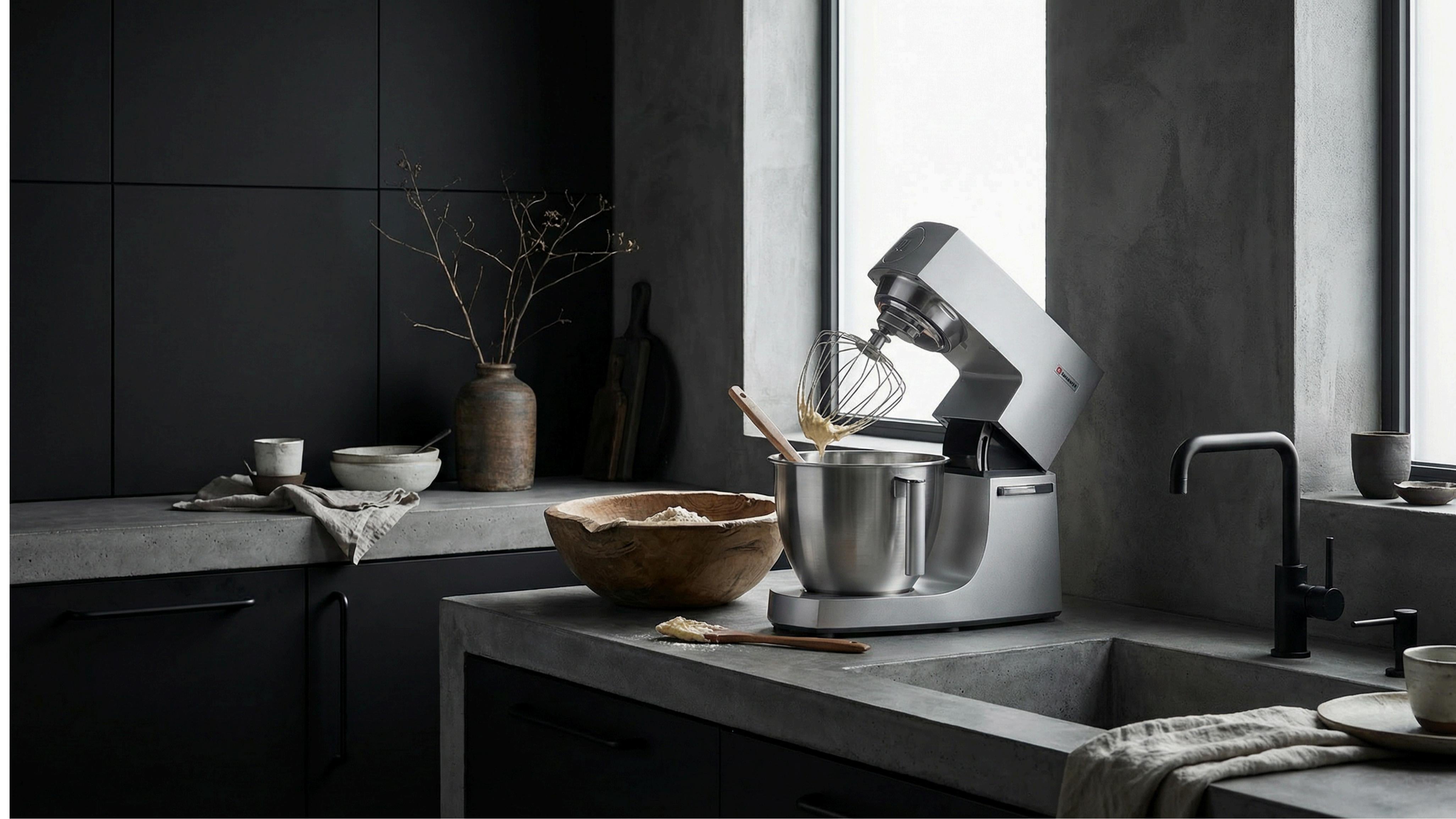
On a tilt-head stand mixer (also called a head-lift mixer), the motor housing pivots upward on a hinge. You tilt the head back, place or remove the bowl, then lock the head back down into mixing position.
How it works: The mixer head tilts back 45-60 degrees. The bowl stays fixed on the base. You add ingredients from the front or side while the head is tilted up.
KitchenAid's Artisan Series popularized this design, but brands including Hauswirt, Cuisinart, and Hamilton Beach now offer tilt-head models with varying motor types and build quality.2
Bowl-Lift Stand Mixers
On a bowl-lift stand mixer, the head stays fixed in place. Instead, you lower and raise the bowl using a lever or crank on the side of the machine. The bowl sits on two metal arms that move up and down.
How it works: You crank the lever to lower the bowl, add ingredients from above, then crank it back up into mixing position. The bowl locks into place against the fixed head.
KitchenAid's Professional 600 Series and Commercial models use this design, as do many 6+ quart machines from other manufacturers. It's the standard for larger-capacity mixers.2
Head-to-Head Comparison
| Factor | Tilt-Head | Bowl-Lift |
|---|---|---|
| Adding ingredients | Easy — tilt back, full access | Moderate — bowl lowers but head partially blocks access |
| Scraping the bowl | Excellent — full visibility, easy reach | Moderate — fixed head obstructs view |
| Changing attachments | Good — access from below | Good — access from below |
| Counter clearance | Fits under standard cabinets (~17") | Needs more vertical space (~17-19" when raised) |
| Common bowl sizes | 3.5-5.5 quarts | 5-8 quarts |
| Dough stability | Can shake/walk with AC motors | More stable due to fixed head design |
| Weight and portability | Lighter (15-25 lbs) | Heavier (25-35 lbs) |
| Durability concern | Tilt-lock mechanism can wear over time | Bowl-lift arms can develop play over time |
| Typical motor type | Historically AC motor | Historically AC motor |
| Price range | $150-$700 | $300-$900+ |
Neither design is universally better. The right choice depends on what you bake, how often, and where your mixer lives.
When a Tilt-Head Mixer Makes More Sense
You bake occasionally, not daily
If you use your mixer a few times a month for cakes, cookies, whipped cream, and the occasional bread dough, a tilt-head gives you everything you need without the extra weight and complexity of a bowl-lift.
Your mixer lives under kitchen cabinets
Standard upper cabinets sit about 17-18 inches above the counter. Most tilt-head mixers are 13-15 inches tall in their resting position, leaving enough room to slide underneath. Bowl-lift mixers are often taller and may not fit. If you plan to store your mixer on the counter permanently — which most owners do, and research shows they use it more often because of it3 — measure your clearance before choosing.
You switch attachments frequently during a recipe
Going from the flat beater to the dough hook to the whisk in one session? Tilt-head makes each swap faster because you just tilt, release, and reattach. Bowl-lift requires lowering the bowl, reaching under the fixed head, and working around the bowl arms.
You make small batches
If you're baking for one or two people, or making half-recipes, a 5-quart tilt-head bowl is the right size. Bowl-lift mixers start at 5 quarts but the minimum mixing volume is often higher — meaning small amounts of egg whites or cream may not reach the beater properly in a large bowl-lift.4
When a Bowl-Lift Mixer Makes More Sense
You make bread dough regularly
This is the single biggest reason people choose bowl-lift. With a fixed head and rigid frame, the bowl-lift design transfers kneading force straight down into the dough rather than rocking the machine body. If you make 2+ loaves per week, a bowl-lift with an AC motor — or a tilt-head with a DC motor — will serve you better than a standard AC tilt-head.
You need 6+ quart capacity
If you regularly bake in large batches — double cake recipes, 4+ loaves of bread, large quantities of cookie dough — a 6-7 quart bowl-lift gives you the capacity. Tilt-head models rarely go above 5.5 quarts. For most home kitchens, our stand mixer collection covers the full size range.
You want the "commercial kitchen" feel
Bowl-lift mixers look and feel more substantial. The lever action, the heavier base, the larger bowl — for some home bakers, the experience matters as much as the performance.
The DC Motor Factor: Why Motor Type Matters More Than Head Design
Here's something you won't find in most tilt-head vs bowl-lift comparisons: the type of motor inside the mixer matters more than how the bowl attaches.
The Real Problem: AC Motor Tilt-Head Instability
Much of the tilt-head "instability" reputation comes from a specific combination: a lightweight tilt-head frame paired with an AC (alternating current) motor.
AC motors deliver power through brushes that create friction, heat, and vibration. In a tilt-head design, that vibration transfers through the hinged joint, causing the machine to rock or "walk" on the counter — and it's also why AC motor tilt-heads run louder than DC motor models — especially when kneading stiff dough.5
This is the origin of the "tilt-head can't do bread" narrative on Reddit and in reviews. And it was largely true — for AC motor tilt-head models.
The Fix: DC Motors
DC (direct current) motors use magnets instead of brushes. They produce:
- Higher torque at low speeds — the motor doesn't bog down when dough resistance increases
- Less vibration — no brush friction means smoother, quieter operation
- Less heat buildup — DC motors run cooler even during extended kneading (10+ minutes)
- Longer lifespan — fewer wear parts mean longer service life
A tilt-head mixer with a DC motor combines the convenience of tilt-head access with the stability and power usually associated with bowl-lift. The hinge point becomes a non-issue because there's simply less vibration to transmit.
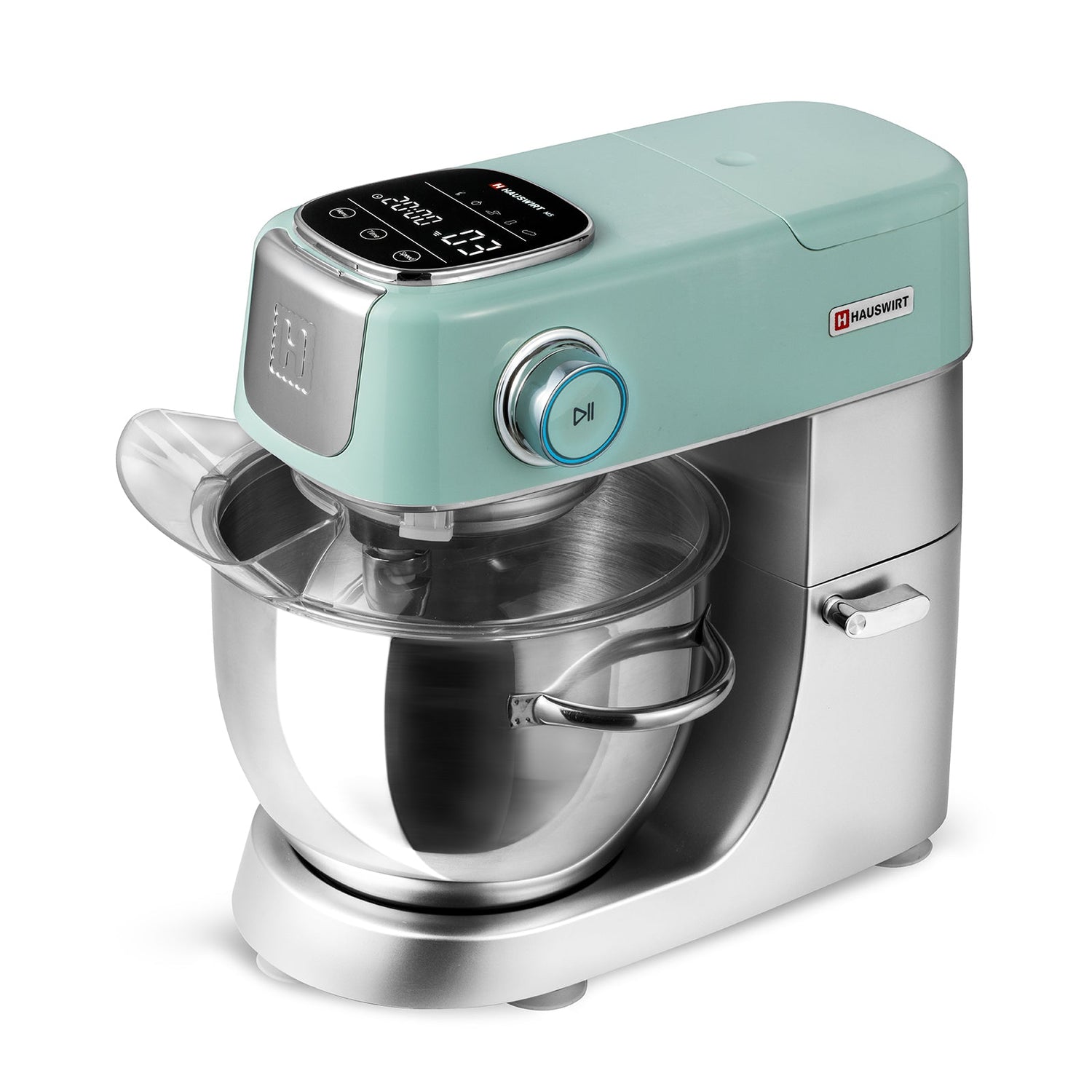
KitchenAid's consumer-grade mixers (Artisan, Classic, Professional 600) all use AC motors. The Hauswirt M5, M5max, and M9 all use DC motors. This is the single most important spec difference between these machines — and it's rarely discussed in buying guides.
If you're comparing models across the tilt-head and bowl-lift categories, check out our Hauswirt vs KitchenAid comparison for a deeper breakdown of how motor type affects real-world performance.

Quick Decision Flow
Choose a tilt-head if:
- You make a mix of cakes, cookies, whipped cream, and occasional bread
- Your kitchen has standard-height upper cabinets
- You value easy ingredient addition and bowl access
- You want a lighter machine that's easier to move
- You choose a model with a DC motor (removes the traditional tilt-head weakness)
Choose a bowl-lift if:
- Bread dough is your primary use case and you bake in large quantities
- You need 6+ quart capacity
- You prefer the fixed-head workflow and don't mind the extra weight
- You have the counter space and don't need to fit under cabinets
Still unsure? Browse our complete stand mixer lineup to compare specs and find the right fit for your kitchen.
FAQ
Can a tilt-head stand mixer handle bread dough?
Yes — if it has a DC motor. A DC motor tilt-head like the Hauswirt M5max can handle 1,500g of dough (about 3 loaves) without walking or overheating. An AC motor tilt-head will struggle with anything over 800-1,000g and may "walk" off the counter.5
Which type is quieter?
DC motor tilt-head mixers are the quietest category overall — about 45dB, comparable to a quiet library. AC motor bowl-lift mixers tend to be louder at medium-high speeds, around 70-80 dB. For detailed specs, see individual product pages like the Hauswirt M5.
Do bowl-lift mixers last longer?
Design alone doesn't determine longevity. Motor type, gearbox material, and maintenance matter more. A DC motor tilt-head with an all-metal gearbox will typically outlast an AC motor bowl-lift with plastic gear components.6
Which type is better for attachments?
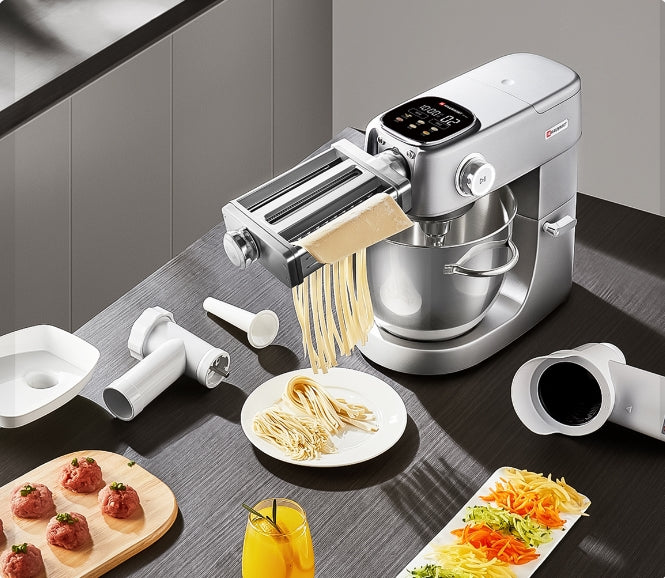
Both designs work with the same hub-mounted attachments (pasta rollers, meat grinders, etc.). Tilt-head offers slightly easier attachment swapping since the head tilts back for access. For a complete guide, read our best stand mixer buying guide.
Is a KitchenAid bowl-lift better than a Hauswirt tilt-head?
It depends on what you value. A KitchenAid Pro 600 (bowl-lift, AC motor, ~$500) gives you larger capacity and a fixed-head design. A Hauswirt M5max (tilt-head, DC motor, $399.99) gives you quieter operation, better dough handling at low speeds, and a more compact footprint. Different priorities, different winners. See our detailed comparison for a full breakdown.
The Bottom Line
The tilt-head vs bowl-lift debate has been framed wrong for years. It's not about which head design is universally better — it's about which combination of head design + motor type + capacity + price fits your kitchen.
For most home bakers who make a mix of cakes, cookies, and bread, a DC motor tilt-head in the 5-5.5 quart range hits the sweet spot: easy to use, stable enough for dough, quiet enough for an apartment kitchen, and priced below comparable bowl-lift models. See our Hauswirt M5max as an example of this category.
The right question isn't "tilt or bowl?" — it's "does this tilt-head have a DC motor?"
Sources
- America's Test Kitchen. "Stand Mixer Reviews." Equipment Corner, 2025. — Independent testing of 15+ stand mixer models across AC and DC motor types, including noise level measurements and dough capacity tests.
- KitchenAid. "Artisan Series 5 Quart Tilt-Head Stand Mixer — Product Specifications." kitchenaid.com, 2025. — Official specs for the most recognized tilt-head model, confirming AC motor type and tilt-head mechanism design.
- National Kitchen & Bath Association. "Kitchen Planning Guidelines." NKBA, 2024. — Standard cabinet height recommendations (17-18" above counter), used to assess countertop appliance clearance.
- Wirecutter (The New York Times). "The Best Stand Mixers." wirecutter.com, 2025. — Independent review noting minimum mixing volumes for 5+ quart bowl-lift mixers and small-batch limitations.
- Reddit r/Baking. "Tilt-head vs bowl-lift for bread dough — real user experiences." 2024-2025. — Community reports of AC motor tilt-head models walking on counters during dough kneading, and DC motor models performing without stability issues.
- Cook's Illustrated. "Understanding Stand Mixer Motors." cooksillustrated.com, 2024. — Technical explanation of AC vs DC motor differences in stand mixers, including torque delivery and heat management.
- Hauswirt. "M5max Stand Mixer — Product Specifications." hauswirt.com, 2025. — Official DC motor, all-metal gearbox, and 1,500g dough capacity specifications.

