

Hand Mixer vs Stand Mixer: Which One Do You Actually Need?
Key Takeaways
- A hand mixer handles 80% of casual baking tasks — whipped cream, cake batter, cookie dough in small batches — and costs $25–$60.
- A stand mixer is non-negotiable for bread dough, large batches, and hands-free multitasking. Its motor won't overheat after 8 minutes of kneading.
- Motor type matters more than wattage. DC motor stand mixers run at 45–55 dB (conversation-level quiet), while traditional AC motor models hit 70–80 dB — a difference most buying guides ignore.
- You don't have to choose once and forever. Start with a hand mixer, upgrade to a stand mixer when your baking outgrows it — that's the path most experienced home bakers actually follow.
- If you bake bread more than twice a month, a stand mixer pays for itself in under 18 months compared to buying artisan loaves.
The Real Question Isn't "Which Is Better"
Walk into any kitchen store or browse a baking forum, and you'll find the same debate: hand mixer or stand mixer? The framing is wrong. It's not a competition — these are two fundamentally different tools that happen to share the word "mixer" in their name.
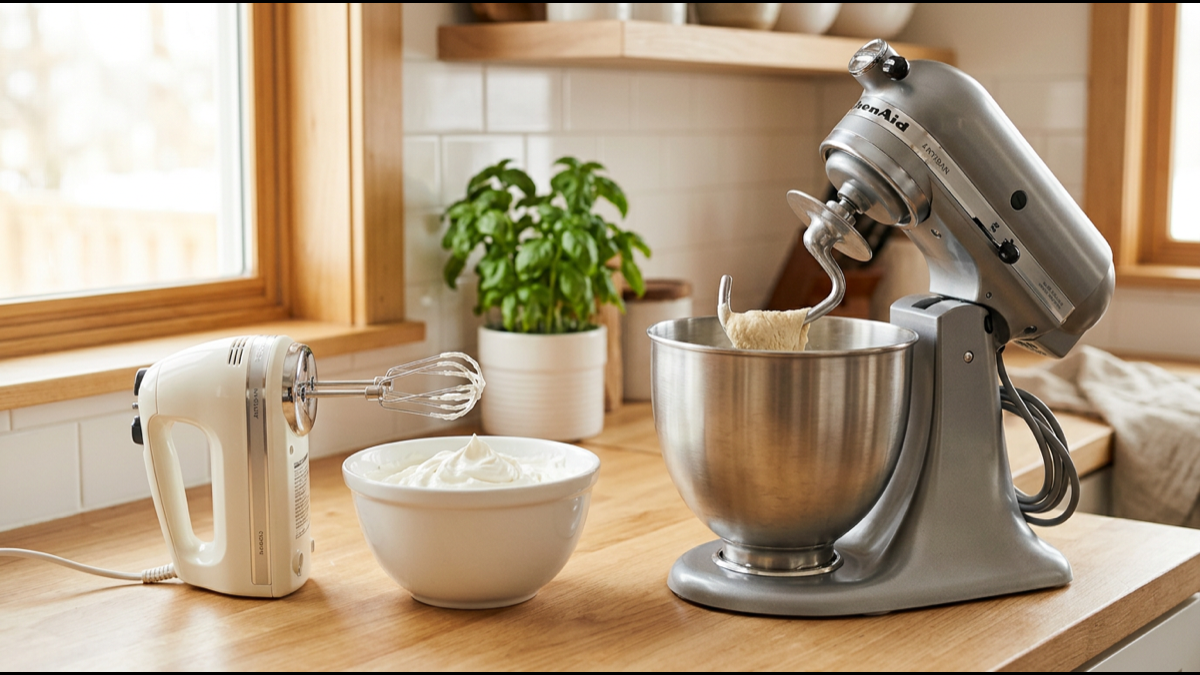
A hand mixer is a lightweight, handheld motor with two spinning beaters. You hold it, move it around the bowl, and control every second of mixing. It costs as little as a pizza dinner and fits in a kitchen drawer.
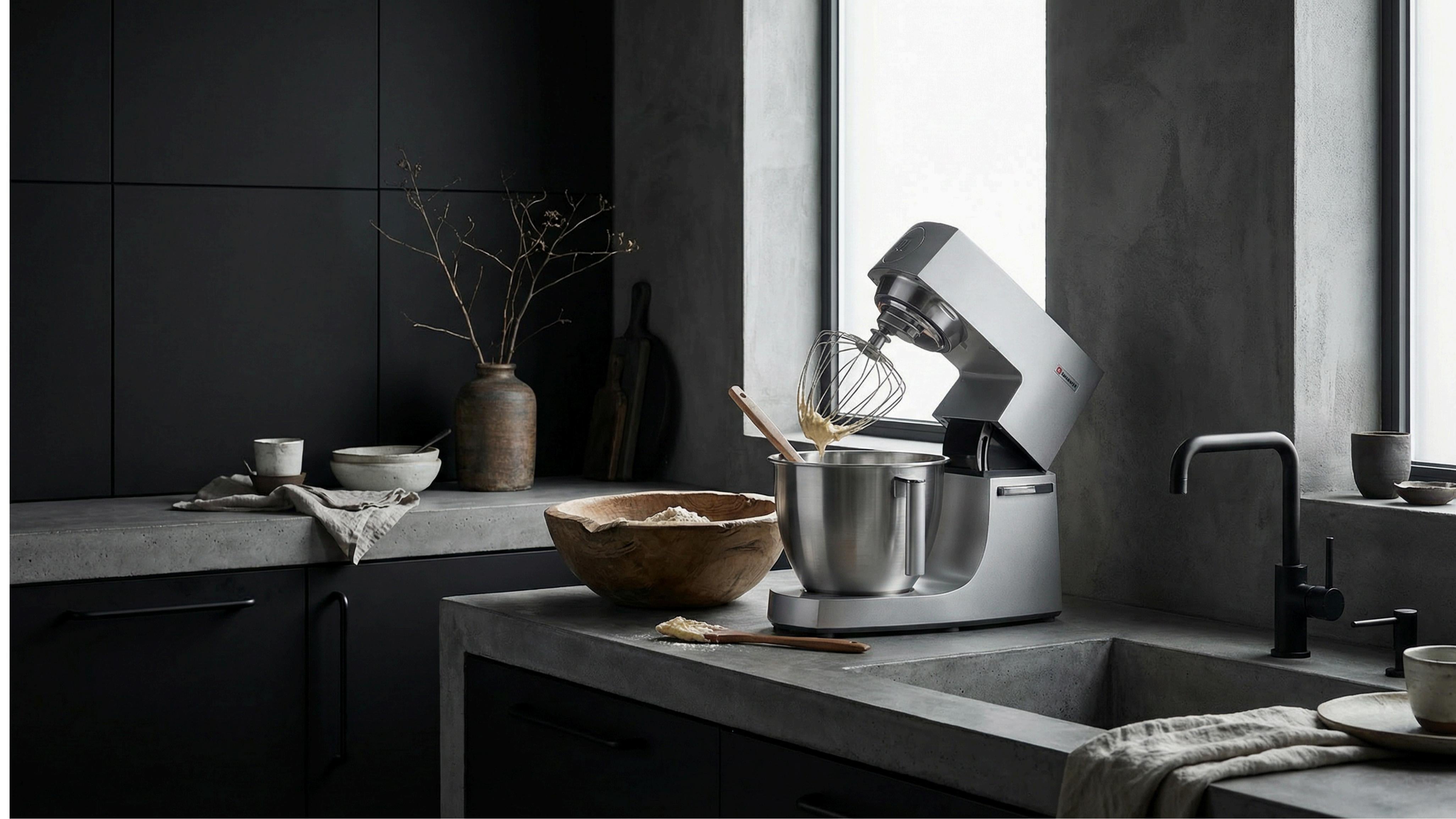
A stand mixer is a countertop machine with a fixed bowl and a motorized head that spins a single attachment — paddle, whisk, or dough hook. It runs hands-free while you measure the next ingredient or wipe down the counter. It costs as much as a decent laptop and weighs 20+ pounds.
The question isn't which one wins. The question is: what are you actually going to make, how often, and how much space do you have? This guide answers that with data — not brand loyalty.
Hand Mixer vs Stand Mixer: The Differences That Actually Matter
| Factor | Hand Mixer | Stand Mixer (AC Motor) | Stand Mixer (DC Motor) |
|---|---|---|---|
| Typical price | $25–$80 | $250–$450 | $250–$500 |
| Motor power | 150–250 watts | 300–575 watts | 300–500 watts |
| Noise level | 65–75 dB | 70–85 dB | 45–55 dB |
| Weight | 2–4 lbs | 20–30 lbs | 15–22 lbs |
| Bowl capacity | Your own bowl | 4.5–7 qt | 5.3–6 qt |
| Operation | Handheld (you control it) | Hands-free (planetary mixing) | Hands-free (planetary mixing) |
| Bread dough | ❌ Motor overheats | ✅ Up to 1,500g flour | ✅ Up to 1,500g flour |
| Attachments | Beaters + whisk + basic dough hooks | Paddle + whisk + dough hook + 10+ add-ons | Paddle + whisk + dough hook + add-ons |
| Lifespan | 5–10 years | 10–20 years | 15–25 years |
| Counter footprint | Zero (drawer) | 10–14" wide, permanent | 10–14" wide, permanent |
The column most guides leave out is the third one. DC motors — the same type used in modern EVs and high-end blenders — are fundamentally quieter and more efficient than traditional AC motors. They deliver full torque at low speeds, which matters for kneading stiff doughs without straining the machine. If noise matters in your kitchen (open-plan living, napping kids, early-morning baking), this difference alone can decide which stand mixer you buy.
When a Hand Mixer Is All You Need
For a surprising number of home cooks, a hand mixer covers everything they actually make. If this sounds like you, save the $300 and the counter space:
- You bake once or twice a month. If your stand mixer would spend 28 days sitting idle, it's expensive counter decor.
- Your batches are small. A single cake, a dozen cookies, whipped cream for a weeknight dessert — a hand mixer handles these without breaking a sweat.
- Counter space is scarce. In an apartment kitchen or a home with limited workspace, a tool that lives in a drawer wins by default.
- You've never made bread dough and don't plan to. This is the single biggest differentiator. No bread = no urgent need for a stand mixer.
- You value quick cleanup. Two beaters rinse in 20 seconds. A stand mixer bowl, paddle, and splash guard take longer.
A quality $30–$50 hand mixer — look for at least 200 watts, 5+ speeds, and a slow-start feature to avoid flour explosions — will serve an occasional baker for years.
When You Should Upgrade to a Stand Mixer
The tipping point is real. Here's when a hand mixer stops being enough:
1. You Make Bread or Pizza Dough
A hand mixer's motor is not built for sustained resistance. Bread dough requires 8–12 minutes of continuous kneading. Try that with a hand mixer and you'll smell burning insulation before the gluten develops. A stand mixer's dough hook and higher-torque motor handle 1,000–1,500g of flour without overheating.
2. You Bake in Volume
Three dozen cookies for a bake sale. A three-layer cake for a birthday. Two loaves of sandwich bread for the week. At this scale, holding a hand mixer for 10+ minutes becomes a workout, and the motor will struggle with dense mixtures.
3. You Want to Multitask
Hands-free operation is not a luxury — it's a workflow change. While the stand mixer creams butter and sugar, you measure flour. While it kneads dough, you grease the pan. This compounds with every bake.
4. You're Interested in Attachments
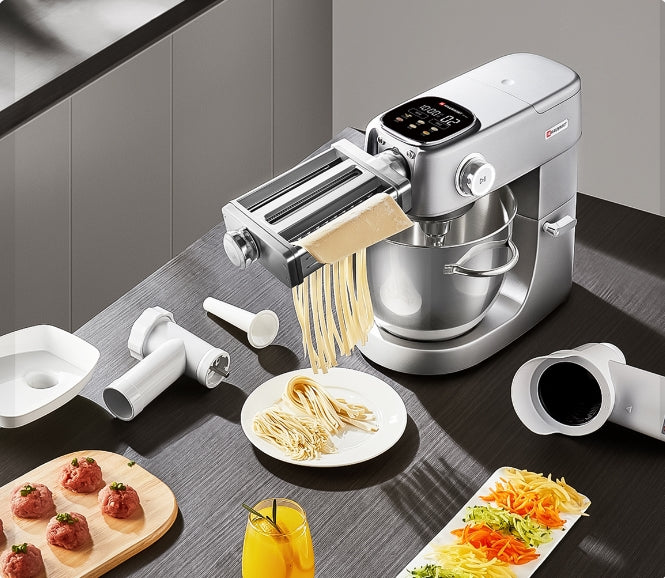
A stand mixer with a power hub becomes a pasta maker, meat grinder, spiralizer, or ice cream maker. These aren't gimmicks — the pasta attachment alone replaces a $200–$300 standalone machine for most home cooks. A hand mixer has no attachment ecosystem.
5. You Have Mobility or Strength Concerns
Holding a vibrating motor for 5–10 minutes is genuinely tiring, especially for people with arthritis, carpal tunnel, or reduced grip strength. A stand mixer eliminates this entirely.
The Noise Factor Nobody Talks About
Noise is the most under-discussed variable in mixer comparisons. Most buying guides mention it in passing ("stand mixers can be loud"), but almost none provide actual data or explain why the difference exists.
The reason: motor type.
Traditional stand mixers use AC (alternating current) motors. These use carbon brushes that create friction, sparking, and noise — typically 70 to 85 decibels. That's between a vacuum cleaner and city traffic. Run one at 6 AM and the whole house knows you're baking.
A growing number of modern stand mixers use DC (direct current) motors. These are brushless — no friction, no sparking, and dramatically less noise. A DC motor stand mixer runs at 45–55 dB, which is conversation-level quiet. You can knead bread dough while someone reads three feet away.
Here's what those numbers mean in practice:
| Noise Level | Equivalent | Mixer Type |
|---|---|---|
| 45 dB | Quiet library, light rainfall | DC motor stand mixer (low speed) |
| 55 dB | Normal conversation, background music | DC motor stand mixer (high speed kneading) |
| 65 dB | Busy office, electric toothbrush | Hand mixer (typical) |
| 75 dB | Vacuum cleaner, loud radio | AC motor stand mixer (kneading dough) |
| 85 dB | City traffic, garbage disposal | Budget AC motor stand mixer (max load) |
Bottom line: If noise matters in your kitchen — and for most people, it does — the question isn't just "hand mixer or stand mixer." It's also "what kind of motor does the stand mixer have?"
Task-by-Task: Which Mixer Wins
| Task | Hand Mixer | Stand Mixer | Verdict |
|---|---|---|---|
| Whipped cream (1–2 cups) | ✅ Fast, great control | ⚠️ Bowl too large for small amounts | Hand mixer wins |
| Whipped cream (3+ cups) | ⚠️ Takes longer, arm fatigue | ✅ Hands-free, consistent | Stand mixer wins |
| 1–2 egg whites | ✅ Better contact with small volume | ⚠️ Whisk can't reach | Hand mixer wins |
| 3+ egg whites (meringue) | ⚠️ Tiring, ~8–10 min hold | ✅ 8–10 min hands-free | Stand mixer wins |
| Creaming butter + sugar | ✅ Works, takes ~25–50% longer | ✅ Faster, hands-free | Either; stand mixer faster |
| Cake batter | ✅ Small to medium batches | ✅ All batch sizes | Either; batch size decides |
| Cookie dough (small batch) | ✅ Works fine | ✅ Also works | Either |
| Cookie dough (3+ dozen) | ❌ Motor struggles, beater clogs | ✅ Easily handles large batches | Stand mixer wins |
| Bread/pizza dough | ❌ Motor overheats, dough hooks useless | ✅ Purpose-built with dough hook | Stand mixer wins |
| Mashed potatoes | ✅ Quick, easy | ✅ With paddle attachment | Either |
| Swiss meringue buttercream | ❌ Can't pour hot syrup while holding | ✅ Hands-free for hot syrup pour | Stand mixer wins |
| Shredding chicken | ❌ No | ✅ Paddle on low speed, 30 seconds | Stand mixer wins |
| Working over double boiler | ✅ Portable, maneuverable | ❌ Fixed position | Hand mixer wins |
Cost Over Time: Is a Stand Mixer Worth It?
A stand mixer is expensive. But "expensive" and "not worth it" aren't the same thing. Let's look at the math.
Take a quality DC motor stand mixer at $300. If you bake twice a week — one loaf of bread, one batch of cookies or a cake — that's roughly 100 uses per year. Over a conservative 10-year lifespan (DC motor models often last 15–20), that's $0.30 per use.
Now compare to what the mixer replaces or enables:
| What You Get | Annual Savings vs Buying / Outsourcing |
|---|---|
| Homemade sandwich bread (2×/week vs $5 artisan loaf) | ~$390/year |
| Homemade pizza (1×/week vs $18 delivered) | ~$780/year |
| Fresh pasta (1×/week vs $6/box premium dried) | ~$200/year |
| Birthday cakes (4×/year vs $40+ custom cakes) | ~$140/year |
Even if you only bake bread — just bread, twice a week — a $300 stand mixer pays for itself in under 18 months. Everything after that is savings. The economics get even better when you factor in the attachment ecosystem: a stand mixer pasta attachment ($60–$100) replaces a standalone machine that costs $200–$300.
A hand mixer doesn't have this math problem because it costs so little upfront. But it also doesn't unlock these capabilities — you can't make bread, pasta, or ground meat with a hand mixer at any price.
The Smart Path: Start Small, Upgrade When Ready
The most common advice in baking communities isn't "buy a stand mixer." It's "start with a hand mixer, upgrade when it holds you back." Here's what that path looks like:
Stage 1: The hand mixer phase. Buy a $30–$50 hand mixer with at least 200 watts, 5+ speed settings, and a slow-start feature. This handles cakes, cookies, whipped cream, frostings, and quick batters. Use it for 6–12 months. Pay attention to what you wish it could do.
Stage 2: The friction point. You'll know it's time to upgrade when one of these happens: (a) you skip making bread because kneading by hand takes too long, (b) you're baking large batches and your arm gets tired holding the mixer, (c) you hear the motor straining on cookie dough, or (d) you want to make fresh pasta and realize you can't.
Stage 3: The stand mixer upgrade. When you buy, prioritize these features:
- Motor type: DC, not AC. DC motors are quieter, more efficient, and last longer. If the product page doesn't say "DC motor," assume it's AC.
- Capacity: 5–6 quarts. This is the sweet spot for most home bakers — big enough for 2 loaves of bread, small enough to whip a single egg white. 7+ quarts is overkill unless you're baking commercially.
- Full metal gearbox. Plastic gears strip under heavy dough loads. All-metal internals last decades.
- Noise level: under 60 dB at max speed. If the spec sheet doesn't list decibels, it's probably loud.
- Tilt-head design. Easier to add ingredients mid-mix and scrape the bowl than bowl-lift designs.
If you're at Stage 3 and want a DC motor machine that hits all five criteria without paying KitchenAid prices, here's what that looks like in practice:

Hauswirt M5 Max 6QT Stand Mixer for Effortless Home Baking
500W DC Motor | 6QT Bowl | 45dB Quiet | 4.5" Touchscreen
This three-stage path means you never overspend on capacity you don't use. And when you do buy a stand mixer, you know exactly what matters because you've already hit the limits of a hand mixer.
FAQ: Hand Mixer vs Stand Mixer
Can a hand mixer knead bread dough?
No. Hand mixer motors (150–250W) lack the sustained torque needed for 8–12 minutes of dough kneading. Some hand mixers include dough hooks, but these are meant for very light, quick doughs — not bread. Attempting full bread kneading will overheat the motor and produce under-developed gluten. Use a stand mixer with a dough hook, or knead by hand.
Is a stand mixer better for whipped cream?
Not necessarily. A hand mixer actually gives you more control over whipped cream — you can see and feel the peaks forming in real time and stop before over-whipping. For 1–2 cups of cream, a hand mixer is faster and easier. For 3+ cups or when you need to multitask, a stand mixer is better.
Can I use a hand mixer instead of a stand mixer for cake?
Yes, for most cake recipes. A hand mixer creams butter and sugar, mixes batter, and whips egg whites effectively for standard-size cakes. It takes about 25–50% longer than a stand mixer for creaming, and you'll need to hold it the whole time. For multi-layer cakes or very large batches, a stand mixer is more practical.
Why are stand mixers so expensive?
The cost is in the motor, gearbox, and build quality. A quality stand mixer has a powerful motor (300–500W), an all-metal gearbox, precision-machined planetary gears, and enough weight to stay stable under heavy loads. Cheap stand mixers cut corners on these components — plastic gears strip, motors burn out, and the machine walks across the counter. A well-built stand mixer lasts 15–25 years, which is why the per-use cost is actually low.
How much counter space does a stand mixer need?
A typical stand mixer is 10–14 inches wide, 14–17 inches tall, and 8–10 inches deep. You need about 18 inches of vertical clearance to tilt the head back. If you have upper cabinets, measure before buying: some models are too tall to fit under standard 18-inch upper cabinets when the head is tilted.
What's the difference between AC and DC motor stand mixers?
AC (alternating current) motors use carbon brushes that create friction, sparking, and noise — typically 70–85 dB. They're the traditional design used by most legacy stand mixer brands. DC (direct current) motors are brushless: no friction, no sparking, quieter operation (45–55 dB), better torque at low speeds, and longer lifespan. DC motor stand mixers are a newer development in the category and typically cost the same as mid-range AC models.
Should I buy a hand mixer first and upgrade later?
Yes, that's the recommended path for most people. A $30–$50 hand mixer handles the vast majority of casual baking tasks. Use it until you hit a clear limitation — bread dough, large batches, or wanting attachments — then upgrade to a stand mixer. This way, you don't spend $300+ on a machine you might only use twice a month.
Do I need both a hand mixer and a stand mixer?
Not at first. Many experienced bakers eventually own both because each excels at different tasks: a hand mixer for quick small jobs (whipped cream, 2 egg whites, single cake) and a stand mixer for heavy lifting (bread dough, large batches, attachments). But start with one — a hand mixer if you're a casual baker, a stand mixer if you already bake bread or large batches regularly.
What to Do Next
Still deciding? Start with a quality hand mixer ($30–$50). Bake with it for a few months. If you never hit its limits, you saved $250+. If you do hit its limits, you'll know exactly what to look for in a stand mixer — and you'll keep the hand mixer for quick jobs.
Already know you need a stand mixer? Prioritize a DC motor, all-metal gearbox, and 5–6 quart capacity. These three specs separate machines that last 5 years from machines that last 20. For a deeper dive into what to look for across the entire price spectrum, read our complete stand mixer buying guide — it covers every price point with real spec comparisons, not just brand names.
Curious about how stand mixers compare to each other? See our detailed Hauswirt vs KitchenAid comparison for a side-by-side breakdown of motor type, noise level, build quality, and real-world performance.
Sources
- Food & Wine — "Can You Use a Hand Mixer Instead of a Stand Mixer?" (2025)
- The Pioneer Woman — "What's the Difference Between a Hand Mixer and Stand Mixer?" (2025)
- KitchenAid — "Stand Mixer vs Hand Mixer" product comparison guide
- Serious Eats — "Stand Mixers vs. Hand Mixers: Which One Should You Buy?"
- Consumer NZ — "Food Mixers Buying Guide" (2026)
- Wayfair — "Hand Mixer vs. Stand Mixer: Which One is Right for You?"
- woman&home — "Can a Hand Mixer Replace a Stand Mixer? Experts Bake Down the Differences" (2025)

