

Key Takeaways
- Most "best stand mixer for bread dough" lists push the wrong machine. A 325W AC motor with nylon gears — the spec behind most $300 tilt-head mixers — will walk, slow, or burn out on a 65% hydration loaf within 10 minutes.
- Quart capacity is a marketing number. What matters is finished dough weight. A 5-quart bowl handles about 750g (one loaf). A 6-quart bowl handles 1.5kg (two loaves). Bakers think in grams, not quarts.
- The 4-stage failure cascade is universal. Walking → slowdown at speed 2 → burning smell → grinding. Stop at slowdown or you'll replace gears by loaf 30.
- Ankarsrum is what serious bread bakers end up on — and overkill for most. At $749 it handles 5kg batches no household needs. A 500W DC motor machine in the $300–400 range covers 90% of home bread bakers.
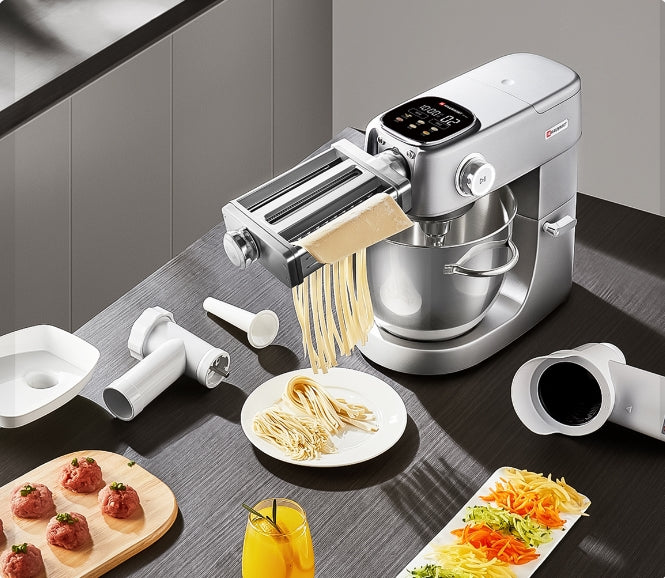
- The Hauswirt M5max hits the bread-specific sweet spot. 500W DC motor, 6-quart bowl (1.5kg dough), 45 dB at speed 2, all for $349 — Ankarsrum-class motor tech at less than half the price.
You bought a KitchenAid Artisan because it looked like the one your mom had. Three sourdough loaves in, it walked itself off the counter, smelled like a dying hair dryer, and now you're here. Most "best stand mixer for bread dough" articles won't tell you why. We will.
What Counts as "Bread Dough" to a Stand Mixer
Stand mixer makers rate bowls by quart volume. Recipe writers talk about cups of flour. The mixer only cares about one thing: dough weight at finished hydration.
Hydration is the water-to-flour ratio by weight, and it's the single biggest predictor of how hard the mixer works. Most people assume high hydration is the killer. It's not. Stiff dough is.
| Dough type | Hydration | Difficulty | Examples |
|---|---|---|---|
| Stiff | 55–62% | Brutal | Bagels, pretzels, sandwich bread |
| Standard | 63–70% | Hard | Sandwich loaves, French bread, brioche |
| High hydration | 71–85% | Medium | Ciabatta, sourdough country loaves |
A 60% hydration bagel dough fights the hook on every rotation. An 80% hydration ciabatta looks messy but offers less mechanical resistance. So when a recipe says "this mixer handles bread," ask which bread.
The Motor Question: AC vs DC vs Belt
Open any Reddit thread on stand mixers for bread and you'll see arguments about wattage. Higher watts must be better, right? Wrong. Wattage measures power consumption, not work output. A 1000W AC motor with cheap gears gets out-kneaded by a 500W DC motor with good ones.
So here's the motor physics in plain English.
AC motors (KitchenAid Artisan, Cuisinart SM-770, most sub-$300 mixers) run fast and rely on a gearbox to slow down. They strain at low RPM and sound like they're dying on bread at speed 2 — because they kind of are.
DC motors deliver high torque at low RPM natively. That's exactly what bread dough needs: slow, powerful kneading. Ankarsrum uses 600W DC, Bosch Universal Plus uses 800W DC, Hauswirt M5max uses 500W DC. Same motor class, different scale.
Belt-drive vs direct-drive is the secondary question. Belt-drive absorbs shocks and runs quieter; direct-drive transfers every dough resistance spike to the gears. This is why the direct-drive KitchenAid Pro 600 is loud even though it's powerful.
Dough Capacity, Translated to Loaves
| Bowl size | Finished dough | Loaf equivalents | Use case |
|---|---|---|---|
| 4.5 quart | 750g | 1 loaf | Small household, weekly |
| 5 quart | 900g | 1 large or 2 small | Family of 2–4 |
| 6 quart | 1.5kg | 2–3 loaves | Serious baker, 2–3x weekly |
| 7 quart+ | 2kg+ | 3+ loaves | Daily baker, large family |
Numbers assume 65% hydration. Drop to 58% (bagels) and the same bowl handles about 20% less dough weight, because the machine works harder per gram. Most first-time buyers overbuy on bowl size and underbuy on motor class — a 6-quart AC motor machine still struggles on bread even though the bowl is big enough.
The 4-Stage Failure Cascade
Stand mixers don't die randomly. They telegraph failure in four stages. Stop at Stage 2 and the machine lives for years. Push to Stage 3 and you'll need new gears by loaf 30.
| Stage | Symptom | What's happening | Action |
|---|---|---|---|
| 1 | Walking on counter | Dough resistance exceeds grip | Normal for stiff dough; hold the head |
| 2 | Slowdown at speed 2 | Motor hitting torque limit | Stop. Divide dough. Or upgrade. |
| 3 | Burning smell | Motor windings overheating | STOP. Cool 30 min. Smaller batch. |
| 4 | Grinding | Gear teeth stripped | Dead. Repair cost exceeds value. |
The jump from Stage 3 to Stage 4 is irreversible — once gears strip, they don't un-strip. If your current mixer is at Stage 1 or 2, you can extend its life with our stand mixer maintenance guide. If it's at Stage 3, replace it before the next loaf.
The Field: 5 Stand Mixer Classes for Bread
| Class | Examples | Motor | Bread capability | Price |
|---|---|---|---|---|
| 1. Lightweight tilt-head | KitchenAid Artisan, Cuisinart SM-770 | 300–500W AC | One loaf max; struggles on stiff dough | $200–350 |
| 2. Pro-style bowl-lift | KitchenAid Pro 600, Breville Bakery Chef (550W) | 525–575W AC, all-metal gears | Two loaves, decent; loud | $400–700 |
| 3. DC motor value | Hauswirt M5max | 500W DC, belt-drive | Two loaves, quiet, long kneading | $349 |
| 4. Belt-drive workhorse | Bosch Universal Plus | 800W DC | Three loaves; high-hydration expert | $450–550 |
| 5. Rotating-bowl tank | Ankarsrum Assistent Original | 600W DC, moving bowl | Five loaves; lifetime durability | $749 |
Class 1 is what most people buy and regret for bread. The Artisan is a great cake mixer, not a bread mixer. Class 2 (Pro 600) is what Reddit eventually recommends — it lasts, but it's loud. Class 3 is where the M5max sits alone: DC motor + belt-drive + sub-$400 + 45 dB. We have a longer breakdown of why DC motor watts hit harder than AC motor watts.

Hauswirt M5 Max 6QT Stand Mixer for Effortless Home Baking
500W DC Motor | 6QT Bowl | 45dB Quiet | 4.5" Touchscreen
Class 4 (Bosch) is a cult favorite for sourdough — excellent motor, but the open-bowl design throws flour everywhere. Class 5 (Ankarsrum) is the machine r/Breadit and Bon Appétit's heavy-duty bakers converge on for bread specifically. The rotating-bowl design mimics hand-kneading better than any other machine. It will outlive you. If you bake daily, get one. If you bake weekly, the math doesn't justify $749.
The Decision Framework
Tier 1 — Occasional baker (1 loaf/week): Your Artisan or Cuisinart is fine. Keep batches under 750g, stop at slowdown.
Tier 2 — Serious home baker (2–4 loaves/week): Where most readers land. A Hauswirt M5max ($349) or Bosch Universal Plus ($499) will change your bread life.
Tier 3 — Daily baker / semi-pro: Buy the Ankarsrum. The $749 hurts once. Replacing a Pro 600 every five years hurts more.
Frequently Asked Questions
Can a KitchenAid Artisan handle bread dough?
Technically yes, but only one loaf at a time, at 65% hydration or softer. Wirecutter's testing shows the Artisan survives a 10-minute two-loaf sandwich bread knead, but on stiff dough like bagels it walks and strains the motor within minutes. Most Artisan owners on Reddit replace gears or upgrade within 2 years of weekly bread baking.
How many watts do you really need for bread?
For AC motors, 500W minimum (575W preferred) — but wattage is misleading because AC motors strain at low RPM. For DC motors, 400–500W handles 1.5kg of bread dough comfortably. Gear material and drive type matter more than raw wattage. A 500W DC motor with all-metal gears outperforms a 1000W AC motor with nylon gears on bread.
Is the Ankarsrum worth it for bread?
For daily bakers and serious sourdough makers, yes. For weekly bakers doing 1–3 loaves, it's overkill — a Hauswirt M5max ($349) or Bosch Universal Plus ($499) covers the same needs at half the price.
What speed should I use to knead bread?
Speed 2. Kneading at higher speeds overheats the dough, oxidizes the flour, and strains the motor. The KitchenAid rule of "speed 2 only for bread dough" applies to every stand mixer. Bread kneads at low speed for 8–12 minutes total, never above speed 3.
What's the difference between a C-hook, spiral hook, and roller?
C-hooks push dough around — cheapest, slowest at developing gluten. Spiral hooks mimic hand-kneading by folding dough under itself — the standard on pro-style mixers and the best choice for bread. Roller-and-scraper designs (Ankarsrum) have a stationary hook with a moving bowl — closest to hand-kneading but only available on Ankarsrum.
Will a 6-quart bowl handle two loaves of bread?
Yes. A 6-quart bowl handles about 1.5kg of finished dough — two standard 750g sandwich loaves or three 500g boules. The limit is 2.5kg before dough climbs the hook and stresses the motor. For three full-size loaves, upgrade to 7-quart or Bosch Universal Plus.
The Bottom Line
The best stand mixer for bread dough has a DC motor, all-metal gears, a spiral or roller hook, and a bowl sized to how much you bake. For most readers that's a 6-quart DC motor machine around $349. For daily bakers, it's the Ankarsrum. For occasional sandwich bakers, it's whatever Artisan-class mixer you already own — just keep batches small.
To compare Hauswirt against the brands you're cross-shopping, see our Hauswirt vs Cuisinart and Bosch comparison and the head-to-head against KitchenAid. The M5max is on its product page here, and the full lineup is on the stand mixer collection.
Sources
- America's Test Kitchen — Stand mixer long-term testing across 50+ bread dough sessions; torque and gear failure analysis. ATK is the most-cited independent kitchen equipment testing authority in the US.
- NYT Wirecutter — "The Best Stand Mixers" (Anna Perling): multi-year testing of KitchenAid, Ankarsrum, Bosch, and Cuisinart models; longevity data and failure modes.
- King Arthur Baking — Stand mixer guides and bread dough hydration references; gold-standard US flour mill educational content on baker percentages.
- r/Breadit, r/AskBaking, r/Sourdough — Aggregated user reports of mixer failures, replacements, and brand preferences among active home bread bakers.

