

Key Takeaways
- Hauswirt stand mixers use a DC motor with side-mounted placement — the motor sits low and centered in the body, not in the head. This means full torque at low speeds, 45dB noise (library-level quiet), and no oversized base required for stability. KitchenAid's AC motor sits in the tilt-head, which forces a heavier base (26 lbs vs 16 lbs) and takes up more counter space.
- The Hauswirt M5max — the North American flagship model — costs $399.99 with a 500W DC motor, 6-quart bowl, 11 speeds, 4.5" color touchscreen with timer, and a 2-year warranty. The KitchenAid Artisan costs $499.99 for a 350W AC motor, 5.0-quart bowl, 10 speeds, no display, and a 1-year warranty.
- KitchenAid's attachment ecosystem is unmatched (30+ attachments spanning pasta rollers to ice cream makers), but the hub is standardized — most third-party and universal attachments work on Hauswirt mixers too.
- A 500-watt DC motor (Hauswirt M5max) outperforms a 350-watt AC motor (KitchenAid Artisan) in every metric that matters for bread bakers: noise, heat, low-speed torque, and the mixer's tendency to walk across the counter during kneading.
- KitchenAid remains the better choice if you want maximum attachment compatibility and 15-year proven reliability data. Hauswirt is the better choice if you want modern motor technology, lower noise, and $150+ back in your pocket.
If you've spent more than ten minutes researching stand mixers, you've hit the same wall every home baker hits: Is KitchenAid really the only option, or am I just paying for the name?
It's a fair question. KitchenAid has owned the stand mixer category for decades. Walk into any wedding registry, any cooking show set, any home baker's Instagram — there it is. The tilt-head silhouette is as recognizable as a Coke bottle.
But here's what most buyers don't realize until after they've handed over $400: the motor inside that iconic Artisan mixer is the same AC design KitchenAid has used since the 1930s. Meanwhile, a generation of competitors — Hauswirt included — has moved to DC motors that run quieter, cooler, and with more usable torque where bread dough actually needs it: at low speeds.
This article compares Hauswirt and KitchenAid stand mixers across the five dimensions that matter when you're spending real money: motor technology, build quality, capacity, features, and price. No brand loyalty. No affiliate-driven recommendations. Just the specs, the trade-offs, and which one makes sense for your kitchen.
Motor Technology: The Difference That Matters Most
Everything a stand mixer does — knead stiff bread dough, whip egg whites, fold delicate batter — comes down to the motor. And the gap between Hauswirt and KitchenAid's motor technology is the single biggest reason to consider Hauswirt.
AC vs DC: Not a Minor Spec Difference
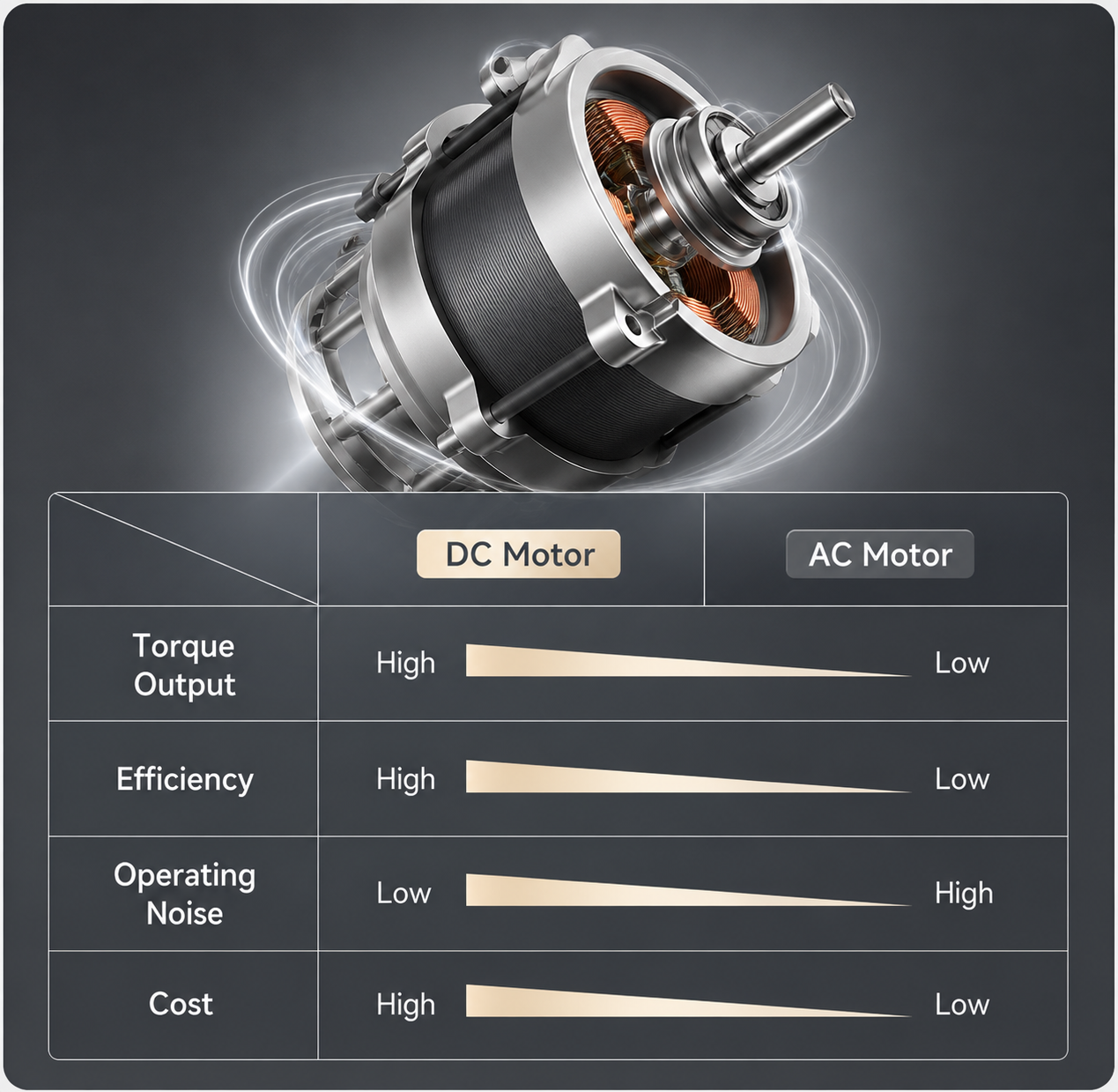
KitchenAid's most popular models — the Artisan, the Classic, the Pro 600 — use AC (alternating current) motors. AC motors are reliable and cheap to manufacture. They've been powering stand mixers for nearly a century. But they have three baked-in weaknesses:
- Torque drops at low speeds. AC motors need RPMs to generate torque. When you're kneading bread dough at speed 2, the motor is operating far below its peak efficiency — which is why AC mixers strain, overheat, and sometimes stall on stiff doughs.
- They're loud. KitchenAid Artisan models typically run at 75–85dB under load. That's somewhere between a vacuum cleaner and city traffic. Fine for a commercial kitchen. Less fine when your kids are asleep or you're on a 7 a.m. conference call.
- They generate heat. AC motors convert more electricity into heat than motion, especially under load. That heat transfers into your dough — and once dough temperature crosses 80°F, yeast activity accelerates uncontrollably. You're fighting your mixer for fermentation control.
DC motors solve all three. Hauswirt uses a DC motor across all three stand mixer models (M5, M5max, M9). DC motors maintain full torque from speed 1, run at 45dB (library-level quiet), and generate significantly less heat — your dough stays cooler during extended kneading cycles.
Motor Placement: The Stability Advantage Nobody Talks About
There's a second motor-related difference that's less obvious but equally important: where the motor sits.
On a KitchenAid Artisan, the motor is housed in the tilt-head — above the bowl, above the hinge, at the very top of the machine. That's a lot of weight sitting high up. To keep the mixer from tipping or walking during kneading, KitchenAid has to make the base disproportionately large and heavy. The Artisan weighs 26 pounds and takes up roughly 14 × 9 inches of counter space — not because the mixing capacity requires it, but because the top-heavy motor placement demands a counterweight.
Hauswirt places the motor in the right side of the body, not in the head. The center of gravity sits lower and closer to the middle of the machine. This means:
- No oversized base required. The mixer stays stable during kneading without needing a heavy cast-iron footprint. The M5max weighs 16 pounds — nearly 40% lighter than the Artisan — and takes up less counter space.
- Easier to move and store. If you store your mixer in a cabinet and lift it onto the counter every time you bake, 10 fewer pounds matters every single time you use it.
- No walking. The lower center of gravity means the mixer doesn't shimmy across the counter during heavy dough kneading — a common complaint with top-heavy AC motor designs.
This is not a minor design preference. It's a fundamentally different engineering choice, and it's why Hauswirt can deliver equivalent or better mixing stability in a smaller, lighter package.
Real Kitchen Impact
| Situation | KitchenAid Artisan (AC Motor, Top-Heavy) | Hauswirt M5max (DC Motor, Side-Mounted) |
|---|---|---|
| Kneading 500g of stiff bagel dough (55% hydration) | Motor audibly strains; mixer may walk across counter; speed 2 struggles, needs speed 4 | Maintains consistent speed at setting 2; low center of gravity keeps it planted; no strain noise |
| Running for 8+ minutes of kneading | Motor housing gets warm to hot; dough temperature rises 5–8°F | Motor stays cool; dough temperature rises 2–3°F |
| Noise level during kneading | 75–85dB — you'll raise your voice to talk over it | 45dB — library-level quiet |
| Double batch of whole wheat dough | Often exceeds recommended capacity; motor may stall; top-heavy design amplifies wobble | Handles within rated capacity without issue; side-mounted motor keeps it stable |
| Lifting mixer from cabinet to counter | 26 lbs — requires two hands and some caution | 16 lbs — one-handed lift for most people |
This isn't marketing. It's physics — both the motor type and where the motor sits determine how the mixer behaves in your kitchen. A DC motor converts electricity into rotational force more efficiently at every speed, and placing it low and centered instead of high and forward keeps the machine stable without adding dead weight.
Model-by-Model Comparison
Rather than speak in generalities, here's how the specific models stack up. Hauswirt's North American flagship is the M5max — it's the model we recommend for most home bakers and the one we'll focus on in our analysis.
| Spec | Hauswirt M5max ⭐ | Hauswirt M5 | KitchenAid Artisan 5-Qt | KitchenAid Pro 600 6-Qt |
|---|---|---|---|---|
| Motor type | DC | DC | AC | AC |
| Motor placement | Side-mounted (low center of gravity) | Side-mounted (low center of gravity) | Head-mounted (top-heavy) | Head-mounted (top-heavy) |
| Power | 500W DC | 300W DC | 350W AC | 575W AC |
| Bowl capacity | 6 Qt | 5.3 Qt | 5.0 Qt | 6.0 Qt |
| Speeds | 11 + pulse | 11 + pulse | 10 | 10 |
| Design | Tilt-head | Tilt-head | Tilt-head | Bowl-lift |
| Display | 4.5" LED touchscreen + timer | 4.5" LED touchscreen | None (manual lever) | None (manual lever) |
| Preset programs | 5 presets + customizable | 5 presets | None | None |
| Weight | ~16 lbs | ~15 lbs | ~26 lbs | ~29 lbs |
| Warranty | 2 years | 2 years | 1 year | 1 year |
| Typical price | $399.99 | $200–230 | $499.99 | $400–500 |
Two numbers jump out immediately: price and weight. The M5max costs $100 less than the KitchenAid Artisan while exceeding it on every technical spec. And at 16 pounds versus 26, it's the difference between a mixer that lives on your counter and one you actually want to lift out of a cabinet.

Build Quality and Durability
Let's address the elephant in the room: KitchenAid has a 100-year track record. You can find 20-year-old KitchenAid mixers still running on eBay. Hauswirt doesn't have that history — the brand is newer to the US market.
But "proven reliability" and "build quality" are not the same thing. Let's separate them.
What KitchenAid Gets Right
KitchenAid's all-metal gear housing on the Artisan and Pro lines is genuinely well-built. The die-cast metal body feels substantial on the counter. Replacement parts are widely available, and YouTube is full of repair tutorials. If something breaks in year 8, you can fix it yourself for $30 in parts.
What's Changed (and What Hasn't)
KitchenAid was acquired by Whirlpool in 1986. Since then, regular users on r/BuyItForLife and r/Kitchenaid report that certain cost-cutting measures have crept in: plastic gear housings on some entry models, coated beaters that chip over time, and a general sense that the 2025 Artisan isn't quite the same as the 1995 one.
Does this mean KitchenAid is poorly built? No. It means they're built to a price point now, and that price point is higher than it's ever been. You're paying for the brand, the marketing, the retail shelf space — and the build quality, while still good, no longer justifies the premium on its own.
Hauswirt's Build: What We Know
Hauswirt uses all-metal gears and a DC motor with fewer moving parts (no brushes to replace). The lighter weight (15 lbs vs 26 lbs for the Artisan) is partly the DC motor — DC motors are inherently smaller and lighter than equivalent AC motors — and partly a design choice that prioritizes portability.
The honest answer on long-term durability: Hauswirt hasn't been in American kitchens for 20 years, so we can't make that claim. But the components — DC motor, metal gears, solid-state electronics — are the same components that high-end brands like Ankarsrum and Famag use in mixers that do last 20 years. The underlying engineering is sound.
Attachments and Ecosystem
This is KitchenAid's strongest hand, and there's no point pretending otherwise.
KitchenAid's attachment hub is standardized across nearly every model they make. You can buy a pasta roller, a meat grinder, a spiralizer, an ice cream maker, a citrus juicer, a grain mill — 30+ attachments — and they all fit. The ecosystem has existed for decades, so third-party manufacturers build for it too.
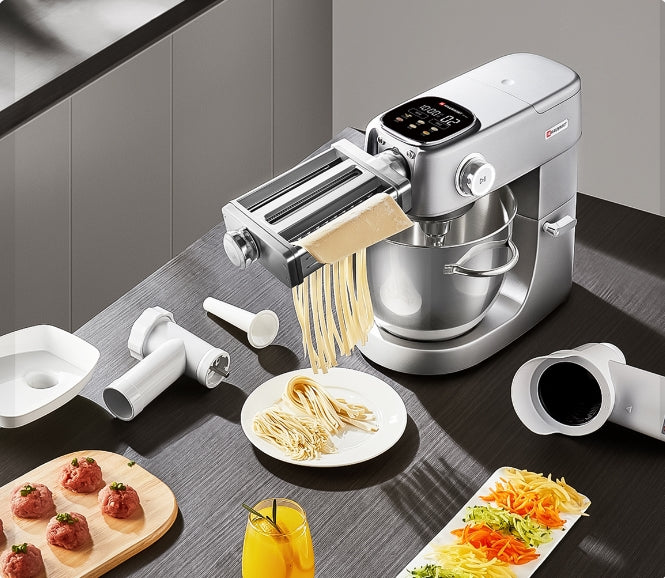
Hauswirt's hub is also a standard power hub, and it accepts many universal-fit attachments. But the dedicated Hauswirt attachment line is smaller. You'll find the essentials — pasta roller set, meat grinder — but you won't find the deep niche options KitchenAid offers.
What this means in practice:
| If you want to… | KitchenAid | Hauswirt |
|---|---|---|
| Use the mixer for mixing, kneading, whipping (90% of use cases) | ✅ Excellent | ✅ Excellent |
| Make fresh pasta occasionally | ✅ Pasta roller attachment | ✅ Pasta roller attachment available |
| Grind meat for burgers or sausage | ✅ Meat grinder attachment | ✅ Meat grinder attachment available |
| Make ice cream, spiralize vegetables, mill grain, juice citrus, shred cheese | ✅ Dedicated attachments for each | ⚠️ Not all available; some require third-party universal attachments |
| Use attachments you already own | ✅ Guaranteed to fit | ⚠️ Check compatibility — most universal-fit attachments will work, but KitchenAid-branded attachments are designed for the KA hub |
Noise: The Overlooked Daily Factor
Spec sheets don't capture what it's like to live with a stand mixer. Noise matters — especially in open-plan homes, apartments, or if you bake while others are sleeping.
KitchenAid Artisan (AC motor): 75–85dB under dough load. Comparable to a vacuum cleaner or a busy street. You will raise your voice to talk over it.
Hauswirt M5max (DC motor): 45dB under dough load. Comparable to a quiet library. You can have a phone call in the same room without the other person knowing you're kneading dough.
That 30–40dB difference is more significant than it sounds. Decibels are logarithmic: a 10dB increase means the sound is perceived as roughly twice as loud. The Hauswirt is subjectively about one-quarter as loud as the KitchenAid during kneading.
This is not a KitchenAid-specific problem — it's an AC motor problem. Every AC stand mixer is louder than every comparable DC stand mixer. If noise is a priority for you, the motor type makes the decision for you.
Price and Value: What the $150–200 Gap Actually Means
At the time of writing, here's what you actually pay:
| Model | Typical Price Range | What You Get for the Money |
|---|---|---|
| Hauswirt M5max ⭐ | $399.99 | DC motor (side-mounted), 500W, 6 Qt, 11 speeds, 4.5" color touchscreen + timer, 5 customizable presets, 2-year warranty, 16 lbs |
| Hauswirt M5 | $200–230 | DC motor (side-mounted), 300W, 5.3 Qt, 11 speeds, LED touchscreen, 5 presets, 2-year warranty, 15 lbs |
| KitchenAid Artisan 5-Qt | $499.99 | AC motor (head-mounted), 350W, 5.0 Qt, 10 speeds, manual speed lever, 1-year warranty, 26 lbs |
| KitchenAid Pro 600 6-Qt | $400–500 | AC motor (head-mounted), 575W, 6.0 Qt, 10 speeds, bowl-lift, 1-year warranty, 29 lbs |
The $100 price difference between the M5max and the KitchenAid Artisan isn't buying you better motor technology or more features. It's buying you the KitchenAid brand, the attachment ecosystem, and 100 years of reputation. Meanwhile, the M5max gives you a more powerful motor (500W vs 350W), a smarter motor placement, a larger bowl (6 Qt vs 5 Qt), a built-in timer, and a longer warranty — for $100 less.

Hauswirt M5 Max 6QT Stand Mixer for Effortless Home Baking
500W DC Motor | 6QT Bowl | 45dB Quiet | 4.5" Touchscreen
Who Should Buy Which?
No single mixer is right for everyone. Here's the honest breakdown:
Buy a Hauswirt M5max if:
- You want modern DC motor technology — side-mounted for stability, inherently quieter, full torque at low speeds
- Noise matters — you bake while family is sleeping, in an apartment, or during conference calls
- Counter space is limited — the side-mounted motor means no oversized base, and at 16 lbs it's easy to move
- You knead bread dough regularly and want consistent torque without the mixer walking across the counter
- You want the best spec-to-price ratio — timer, presets, touchscreen, and 6 Qt capacity for $100 less than the KA Artisan
- You mainly use your mixer for mixing, kneading, and whipping (not niche attachments)
Buy a KitchenAid if:
- Hauswirt M5max Review: DC Motor Power at a Mid-Range Price — our full hands-on review of the M5max
- You want the widest attachment ecosystem available (30+ dedicated attachments)
- Long-term repairability matters — you want parts availability and repair tutorials guaranteed for 15+ years
- You already own KitchenAid attachments
- The brand name and aesthetic matters to you (gift/registry/want that iconic look on your counter)
- You're buying used or refurbished — a secondhand KitchenAid at $150–200 is a genuinely good deal
Frequently Asked Questions
Is Hauswirt as good as KitchenAid?
In motor technology, noise, and modern features, Hauswirt is objectively better. In attachment ecosystem, brand history, and repairability data, KitchenAid leads. "As good as" depends on which of those things you value. For bread bakers who care about dough handling and noise: Hauswirt is the better mixer. For attachment enthusiasts and brand loyalists: KitchenAid remains the safer choice.
Does Hauswirt have the same attachments as KitchenAid?
Hauswirt offers the core attachments most home bakers actually use — pasta roller set, meat grinder, additional mixing accessories. It does not offer KitchenAid's full 30+ attachment catalog (ice cream maker, spiralizer, grain mill, etc.). The power hub is standardized, so many universal-fit third-party attachments will work, but KitchenAid-branded attachments are designed specifically for KA hubs.
Why is Hauswirt so much cheaper than KitchenAid?
Three reasons. First, KitchenAid charges a significant brand premium — you're paying for the name, the marketing, and the retail shelf space. Second, DC motors are actually cheaper to manufacture than equivalent AC motors (fewer copper windings, fewer moving parts). Third, Hauswirt sells direct-to-consumer, while KitchenAid maintains retail partnerships that add markup at every step.
Can a Hauswirt stand mixer knead bread dough?
Yes — and it does it better than most AC motor mixers in its price range. The DC motor maintains full torque at speed 2, which is the correct speed for kneading. It handles up to 1.5 kg (about 3.3 lbs) of dough per batch, which covers two standard loaves. There's no walking, no burning smell, and the motor doesn't strain audibly the way an AC mixer does on stiff doughs.
How long will a Hauswirt stand mixer last?
Hauswirt uses all-metal gears and a brushless DC motor — both are the same engineering choices that give high-end mixers their 15–20 year lifespans. The company offers a 2-year warranty (double KitchenAid's 1 year), which suggests confidence in their build. Long-term durability data isn't available yet since Hauswirt is newer to the US market, but the components are the right ones for longevity.
Is KitchenAid worth the extra money?
If you plan to use your mixer for standard baking tasks (mixing, kneading, whipping) and don't need 30+ specialized attachments: no, the extra $100 is not buying you better performance. In fact, the M5max has a more powerful motor (500W vs 350W), a larger bowl (6 Qt vs 5 Qt), a built-in timer and touchscreen (neither on the Artisan), and runs quieter (45dB vs 75-85dB). If you already own KA attachments, care about maximum repairability, or want the widest attachment ecosystem available: yes, KitchenAid's premium may be worth it for your specific needs.
Which Hauswirt model competes with the KitchenAid Artisan?
The Hauswirt M5max is the direct competitor — and in most technical respects, it surpasses the Artisan. It offers a 500W DC motor (vs 350W AC) with more torque at low speeds and quieter operation, a larger bowl (6 Qt vs 5.0 Qt), a built-in timer and 4.5" color touchscreen (vs manual lever with no display), and a side-mounted motor that keeps the mixer stable without the Artisan's 26-pound base. All of this for $399.99 — $100 less than the Artisan.
See also:
- Hauswirt M5 vs M5max vs M9: Which Model Is Right for You? — a side-by-side breakdown of all three Hauswirt stand mixers
What to Do Next
If the DC motor advantage, side-mounted motor stability, lower noise, larger bowl, and $100 savings matter to you, the Hauswirt M5max is the practical choice — better motor technology, smarter engineering, and less money. Browse the full specs, compare colors, and check current pricing at the link below.
If attachment variety or the security of a 100-year brand is more important to your purchase decision, KitchenAid remains a solid mixer — and there's nothing wrong with choosing peace of mind over raw specs.
Still undecided? Read our complete stand mixer buying guide for a broader comparison across all brands and price points.
If you're considering other KitchenAid alternatives: Read our Cuisinart vs Bosch vs Hauswirt comparison for a three-way breakdown of the top non-KitchenAid stand mixer brands — including motor types, build quality, and which one fits your baking style.
Sources
- Hauswirt product specifications — hauswirt.com product pages for M5, M5max, and M9 stand mixers
- KitchenAid product specifications — kitchenaid.com product pages for Artisan 5-Qt and Pro 600 Series
- User experiences from r/Baking, r/Breadit, r/Kitchenaid, r/BuyItForLife — aggregated sentiment and recurring pain points from Reddit stand mixer discussions
- "Is a KitchenAid really the only stand mixer worth buying?" — BBC Good Food, 2025
- "I Tested the KitchenAid Stand Mixer Against a More Affordable Dupe" — Delish, 2025
- DC vs AC motor principles in kitchen appliances — engineering analysis based on published motor specifications and physics

