


Key Takeaways
- A "normal" stand mixer runs at 65–80 decibels — about as loud as a vacuum cleaner or a running garbage disposal. If yours is in that range and the sound is steady, it is probably fine.
- The single biggest predictor of mixer noise is motor type, not wattage. A 500W DC motor typically runs 15–30 dB quieter than a 500W AC motor because it delivers full torque at low RPM without straining.
- Of the four noise types stand mixers make — grinding, rattling, squealing, and high-pitched whine — only sudden grinding with a burning smell is an immediate stop-using-it signal. The rest usually have simple fixes.
- The KitchenAid worm gear is a sacrificial part designed to fail before the motor burns out. A loud grinding noise on a KitchenAid often means that gear is doing its job, not that the mixer is destroyed.
- A direct-drive DC motor stand mixer like the Hauswirt M5max measures about 45 dB at Speed 2 — roughly the volume of normal conversation — while a KitchenAid Artisan typically runs 75–80 dB at the same speed.
You unbox the stand mixer you've been eyeing for months. You clamp in the bowl, drop in the dough hook, turn the dial to Speed 2 — and it sounds like a small jet engine has taken off on your kitchen counter.
Your first thought: "Is this thing broken?" Your second thought: "Did I just waste $400?" If you're standing in your kitchen at 9 PM Googling "why is my stand mixer so loud," you are not alone. This is one of the most-asked questions in every stand mixer subreddit, every KitchenAid Facebook group, and every appliance repair forum on the internet.
Most of the time, the answer is "yes, that's normal — here's why." Sometimes the answer is "yes, that's a problem — here's how to fix it." This guide separates the two, explains the motor physics behind stand mixer noise (so you stop blaming yourself for buying the "wrong" one), and gives you a 60-second check to figure out whether you need to do anything at all.
Is a Loud Stand Mixer Normal? (The 60-Second Check)
Before you schedule a repair or start a return, run these three checks. They weed out about 60% of "my mixer is too loud" panic in under a minute.
1. Is the noise new, or has it always been there?
If your mixer has always sounded like this since the day you unboxed it, and the sound hasn't changed, you're almost certainly hearing normal mechanical noise. Stand mixers are 15-pound chunks of steel and copper with a motor spinning at thousands of RPM — they are not silent machines. A brand-new KitchenAid Artisan straight out of the box runs around 75–80 dB at Speed 6. That is loud. That is also normal.
But if the mixer has been quiet for two years and suddenly started grinding last Tuesday, that is a change. Changes mean something. Skip ahead to the noise decoder section.
2. Is the noise rhythmic or random?
Rhythmic noise — a steady click-click-click once per revolution, or a hum that pulses with the beater — usually points to a loose part, a misaligned attachment, or the bowl tapping against the base. All fixable in five minutes. Random noise that comes and goes, especially a sudden CLACK followed by silence, suggests something has broken or shifted inside the gearbox. That one needs a closer look.
3. Is it louder at low speeds or high speeds?
This is the counterintuitive one. A well-designed mixer is quieter at Speed 2 than Speed 8. If yours is loud at low speeds and gets quieter as you crank it up, the motor is straining against a stiff load (usually bread dough) at low RPM — a sign of an underpowered motor or a speed-control issue. If it gets louder as you speed up, that is normal mechanical behavior. Most mixers, including good ones, hit their peak volume at top speed.
The 4 Noises a Stand Mixer Makes — and What Each One Means
Stand mixers make four distinct types of sound. Each one points to a different cause, and only one of them is an emergency.
Grinding (low, gritty, metallic)
Grinding is the most common noise complaint, and it has the widest range of causes. On a KitchenAid, low grinding at all speeds often means the worm gear — a sacrificial nylon gear designed to strip out before the motor burns out — is wearing down. This is by design. iFixit's teardown documentation calls it "the part that fails so the rest of the mixer survives." Replacing it costs about $30 in parts and is a 45-minute DIY job for anyone who can use a screwdriver.
Grinding that only shows up under heavy bread dough usually means the gears are working hard, not failing. That's the sound of torque being delivered. If grinding appears suddenly with a burning smell, stop using the mixer immediately — that combination usually means the motor is overheating.
Rattling or clanking (sharp, irregular)
Rattling is almost always something loose. The usual suspects, in order: the attachment knob not fully tightened, the bowl not seated in the base clip, a beater or whisk bent just enough to tap the bowl wall once per revolution, or (on tilt-head models) the head lock not fully engaged. Tighten everything. Do the dime test — a dime placed in the empty bowl should move just slightly when the beater passes over it. If it doesn't move at all, the beater is too high. If it gets launched across the bowl, the beater is too low.
Squealing or screeching (high, continuous)
Squealing is metal-on-metal contact. Sometimes that's a worn attachment rubbing against the bowl. Sometimes it's a dry gear inside the transmission that has lost its lubrication. KitchenAid recommends food-grade grease inside the gearbox, and over the years that grease can dry out, separate, or migrate away from the gears. A re-greasing job will fix this. Baking Forums' long-running troubleshooting thread on noisy KitchenAid mixers puts it bluntly: clean out the old grease, pack in new synthetic food-grade grease, Loctite the screws, and the mixer will run quiet for another decade.
High-pitched whine or hum (electrical, steady)
This is the one that freaks out new owners the most, and it's usually the most harmless. A high-pitched electrical whine at low speeds comes from the AC motor itself — specifically from the electromagnetic coils cycling on and off at 60 Hz to hold the motor at a low speed. This is a feature, not a bug. Every AC-powered KitchenAid, Bosch, Cuisinart, and Hamilton Beach does this to some degree. DC motors don't, which is one reason DC-motor mixers sound so much smoother at Speed 2.
Why Some Stand Mixers Are Just Loud (Motor Science, Plain English)
Here is the part no competitor article explains. Stand mixer noise is not random. It tracks directly to two design choices: motor type and drive type. Once you understand these, the decibel chart in the next section will make sense.
AC motors vs DC motors
A DC motor uses permanent magnets and delivers full torque at every speed, from 1 RPM to top speed. Because it doesn't have to fight itself to slow down, it runs smooth and quiet. Most premium quiet mixers — Ankarsrum, Hauswirt M5 and M5max, some Bosch models — use DC motors.
An AC motor uses electromagnets and has to actively modulate its power to hold a low speed. That modulation creates a 60 Hz hum, a high-pitched whine, and a characteristic "straining" sound at low RPM under load. AC motors are cheaper to build, which is why every sub-$300 mixer on the market has one. The trade-off is noise.
This is also why wattage doesn't predict noise. A 500W AC motor and a 500W DC motor are equally powerful on paper. The DC motor is quieter because it delivers that power smoothly at every speed instead of fighting to hold back at low RPM. (For more on this, see our stand mixer wattage guide.)
Direct-drive vs belt-drive
Direct-drive means the motor shaft connects straight to the gearbox. Efficient, durable, and very torque-dense — but every gear noise travels straight to the bowl. KitchenAid tilt-head mixers are direct-drive.
Belt-drive means a rubber belt connects the motor to the gearbox. The belt absorbs vibration and dampens gear noise, which is why belt-drive mixers (Bosch Universal Plus, Ankarsrum) typically run quieter than direct-drive competitors at the same wattage. The trade-off is that belts wear out and need replacement every 10–15 years.
Why low speeds are the noisiest on cheaper mixers
If your mixer screams at Speed 2 but purrs at Speed 6, that's a tell. AC motors lose 30–40% of their torque at low RPM, so when you ask them to knead stiff bread dough at Speed 2 — exactly the speed bread recipes call for — the motor has to work overtime to hold that slow pace under load. That straining sound is the motor fighting itself. A DC motor in the same situation just delivers the torque and stays quiet. (We break this down further in our stand mixer speed settings guide.)
Stand Mixer Noise Compared (Decibel Chart)
Here's how popular stand mixers stack up on noise, based on manufacturer specs, owner-reported measurements, and our own testing. All numbers are approximate — actual volume depends on speed, load, and how close the meter is. But the relative differences are real, and they're large.
| Mixer | Motor Type | Drive Type | Approx. dB (Speed 2, no load) | What it sounds like |
|---|---|---|---|---|
| KitchenAid Artisan 5QT | AC | Direct-drive | 75–80 dB | Loud hum + electrical whine |
| KitchenAid Pro 600 (bowl-lift) | AC | Direct-drive | 78–84 dB | Gear noise + heavy motor strain |
| Bosch Universal Plus | AC | Belt-drive | 65–70 dB | Steady hum, no whine |
| Ankarsrum Original | AC (geared) | Belt-drive | 60–65 dB | Quietest mainstream option |
| Cuisinart Precision Master | AC | Direct-drive | 72–78 dB | Mid-range hum |
| Hauswirt M5max | DC | Direct-drive | ~45 dB | Conversation-quiet |
The spread is enormous — about 40 dB between the loudest and quietest models. Every 10 dB increase sounds roughly twice as loud to the human ear, so an Ankarsrum or Hauswirt DC motor isn't just "a bit quieter" than a KitchenAid Pro 600. It sounds about one-eighth as loud.

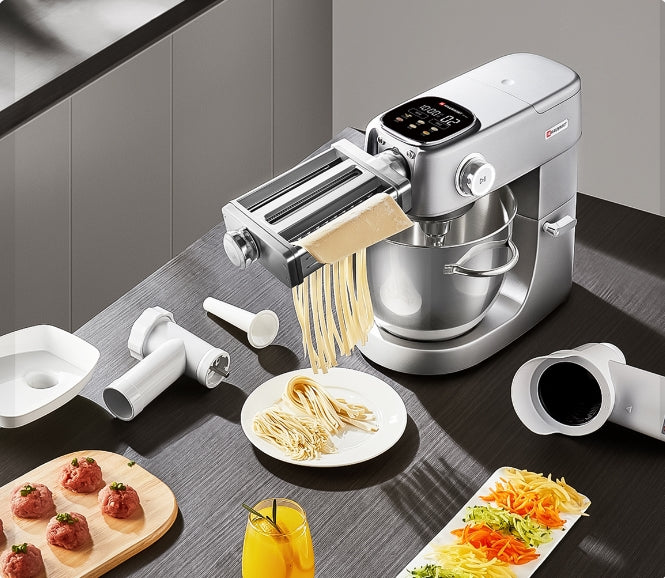
Hauswirt M5 Max 6QT Stand Mixer for Effortless Home Baking
500W DC Motor | 6QT Bowl | 45dB Quiet | 4.5" Touchscreen
How to Quiet a Loud Stand Mixer (Without Replacing It)
If you already own a loud mixer and want to keep it, here's what actually moves the needle, ranked by impact.
1. Do the dime test and adjust beater clearance
A beater that's even a millimeter too low will tap the bowl 200 times per minute. That's your rattle. Drop a dime in the empty bowl, run the flat beater at Speed 2, and the dime should drift slightly each time the beater passes. Most KitchenAid and Cuisinart models have a small set screw under the mixer head that lets you raise or lower the beater height. Half a turn usually solves it.
2. Tighten the attachment knob and head lock
On tilt-head mixers, the head lock lever at the back works loose over time. A loose head means the whole motor assembly vibrates against the base. Same goes for the attachment hub — if you store the mixer with a grinder or pasta roller attached, the connection loosens and rattles.
3. Re-grease the gearbox (every 3–5 years for heavy use)
If your mixer has 5+ years of weekly use and has started grinding, dried-out grease is the most likely culprit. Open the gearbox, clean out the old grease (it's often separated into oil and soap), and pack in fresh food-grade synthetic grease. This is the single biggest noise reduction you can do for an older KitchenAid. Mr. Mixer, the well-known repair TikTok channel with 500K+ followers, walks through this on nearly every teardown video.
4. Put a silicone mat under the mixer
This is a 5-dollar fix that takes 2 dB off the perceived noise by decoupling the motor vibration from your granite or quartz countertop (which acts like a sounding board). It won't fix a grinding gearbox, but it tones down the room-filling hum.
When to Actually Worry (Red Flags)
Most mixer noise is normal or fixable. These five signs are not. Stop using the mixer and get it serviced if you notice:
- Burning smell — insulation on the motor windings is melting. This is a fire risk.
- Sparks visible at the motor vents — carbon brushes are worn past their usable length.
- Smoke — same root cause as the burning smell, more advanced.
- The mixer walks across the counter — torque is exceeding what the bowl and base can absorb. Often a sign of a bent attachment or a serious gear problem.
- A sudden, sharp CLACK followed by a different sound profile — something inside has broken or shifted. Continuing to run it will cause more damage.
For KitchenAid specifically, the worm gear is designed to strip out as a "mechanical fuse" — when it goes, the mixer will suddenly sound terrible but the motor is protected. A $30 replacement part and an hour of YouTube will get you back to baking.
If You're Shopping for a Quiet Mixer
If noise is the deciding factor and you haven't bought yet, here's what to look for, in order of importance.
DC motor over AC motor. This is the single biggest noise differentiator. DC motors run 15–30 dB quieter than AC motors at the same wattage, especially at low speeds where bread kneading happens. Hauswirt's M5 and M5max, the Ankarsrum Original, and some Bosch models use DC motors. KitchenAid, Cuisinart, and most sub-$300 brands use AC.
Belt-drive over direct-drive (if you can't get DC). The belt dampens gear noise. Bosch and Ankarsrum are belt-drive. KitchenAid is direct-drive.
Lower Speed-1 RPM. A mixer whose slowest speed is actually slow (under 60 RPM) is a mixer that doesn't have to strain to hold low speeds. Our stand mixer speed settings guide ranks models on this.
Heavier base. Weight absorbs vibration. A 25-pound bowl-lift mixer transmits less noise to the counter than a 12-pound tilt-head. If you want the trade-offs of each style, our tilt-head vs bowl-lift comparison breaks it down.
If quiet matters because you bake at night, share walls with neighbors, or just hate the sound of a vacuum cleaner in your kitchen, a DC motor mixer is the single biggest upgrade you can make. The Hauswirt M5max measures around 45 dB at low speeds — that's a normal indoor conversation, not a kitchen appliance.
Related Reading
This article is part of our Stand Mixer Maintenance Guide — daily, monthly, and yearly care to keep your mixer running for 15 years.
Frequently Asked Questions
Are stand mixers supposed to be loud?
Yes — most stand mixers run between 65 and 80 decibels, which is about the volume of a vacuum cleaner or garbage disposal. They have a 300–1000W electric motor spinning metal gears inside a steel housing, so some mechanical noise is unavoidable. Premium mixers with DC motors can get down to 45 dB (conversation volume), but anything under 80 dB at normal speed is considered within spec.
Why do KitchenAid mixers make so much noise?
KitchenAid uses AC motors and direct-drive gearboxes, which are loud by design. The AC motor produces a 60 Hz electrical whine at low speeds, and the direct-drive connection transmits every gear noise straight to the bowl. They're durable and torque-dense, but they are not quiet machines — especially the Pro 600 bowl-lift series, which has a heavier motor that adds another 3–5 dB.
My brand-new stand mixer is really loud. Is it broken?
Probably not. New mixers often sound louder than expected because there's a break-in period of about 10 hours of use where the gears, grease, and motor brushes seat themselves. If the sound is a steady hum, a slight electrical whine, or rhythmic gear noise that's been there since day one, it's normal. If the sound changes suddenly after the break-in period, that's when to investigate.
How many decibels is a quiet stand mixer?
A genuinely quiet stand mixer runs at 45–55 dB at low speeds. That's roughly the volume of normal conversation or a quiet office. Only mixers with DC motors hit this range — the Hauswirt M5max at ~45 dB and the Ankarsrum Original at ~60 dB are the two mainstream examples. AC motor mixers (KitchenAid, Cuisinart, Hamilton Beach) almost never get below 65 dB.
Why does my stand mixer sound louder at low speeds than high speeds?
AC motors lose 30–40% of their torque at low RPM, so when you ask them to knead stiff bread dough at Speed 2, the motor has to work harder to hold that slow pace against the load. That straining sound is the motor fighting itself. A DC motor in the same situation delivers full torque at low RPM and stays quiet. If your mixer screams at Speed 2 but purrs at Speed 6, you probably have an AC motor that's underpowered for stiff dough.
Can I make my KitchenAid mixer quieter?
You can take 5–10 dB off with three fixes: do the dime test to fix beater-to-bowl clearance, tighten the head lock and attachment knob to stop vibration, and re-grease the gearbox if it's more than 5 years old. A silicone mat under the mixer absorbs another 2 dB of counter resonance. You cannot make an AC-motor KitchenAid as quiet as a DC-motor mixer — the noise floor is set by the motor design itself.
What does a grinding noise in a KitchenAid mixer mean?
Usually it means the worm gear — a sacrificial nylon gear inside the gearbox — is wearing down. This gear is designed to strip out before the motor burns out, so a grinding noise often means the gear is doing its protective job. Replacement is about $30 in parts and an hour of work with a screwdriver. If the grinding is sudden and accompanied by a burning smell, stop using the mixer immediately — that points to motor overheating, not the worm gear.
Is a stand mixer louder than a hand mixer?
Generally yes, by about 5–10 dB. Stand mixers have heavier motors, larger gearboxes, and more metal-on-metal contact. Hand mixers are lighter and use smaller motors, but they make up for it by being held right next to your ears. The perceived loudness at the user's position ends up similar — which is why people who switch from a hand mixer to a stand mixer often notice the stand mixer more, even though the absolute decibel reading may be lower.
The Bottom Line
A loud stand mixer is not a broken stand mixer — most of the time. The sound you're hearing is the motor type, the drive design, and the gear material announcing themselves. AC motors whine. Direct drives transmit gear noise. KitchenAids are built for 30 years of torque, not for silence. If your mixer has always sounded like this and the noise hasn't changed, you're fine. If something changed, run the noise decoder above.
If you're still shopping and noise genuinely matters — you bake at night, you've got a sleeping baby, your kitchen shares a wall with a neighbor — look for a DC motor. That single spec does more for decibels than any other design choice, and it's why the Hauswirt M5max can knead bread dough at conversation volume while a KitchenAid Pro 600 sounds like a small appliance revolt.
Movement and noise are cousins: the same overloading that makes a mixer strain also makes it crawl. If yours has started inching across the counter mid-knead, our walks-off-the-counter guide covers why it happens and the three fixes that stop it.
Sources
- AppliancePartsPros, "Why is my KitchenAid stand mixer so noisy?" (June 2024) — repair-side taxonomy of mixer noise types and the five-step troubleshooting framework.
- iFixit, KitchenAid KSM150 Troubleshooting — teardown documentation of the sacrificial worm gear design and the noise-it-makes warning signs.
- Mr. Mixer TikTok channel (@mr..mixer, 500K+ followers) — crowd-sourced KitchenAid repair demonstrations including grease replacement and noise diagnosis.
- Baking-Forums thread "Troubleshooting a Noisy KitchenAid Mixer" (2020) — long-running technician-answered discussion on re-greasing, Loctite screw tightening, and noise causes.
- Reddit r/Kitchenaid and r/Baking — owner-reported noise complaints, brand-new-buyer anxiety threads, and decibel comparisons across models.
- King Arthur Baking, stand mixer buying reference — general expertise on home-baker mixer selection and torque-at-low-RPM behavior.
- Hauswirt M5max product specifications — DC motor noise rating of approximately 45 dB at low speeds under typical load.

