

Key Takeaways
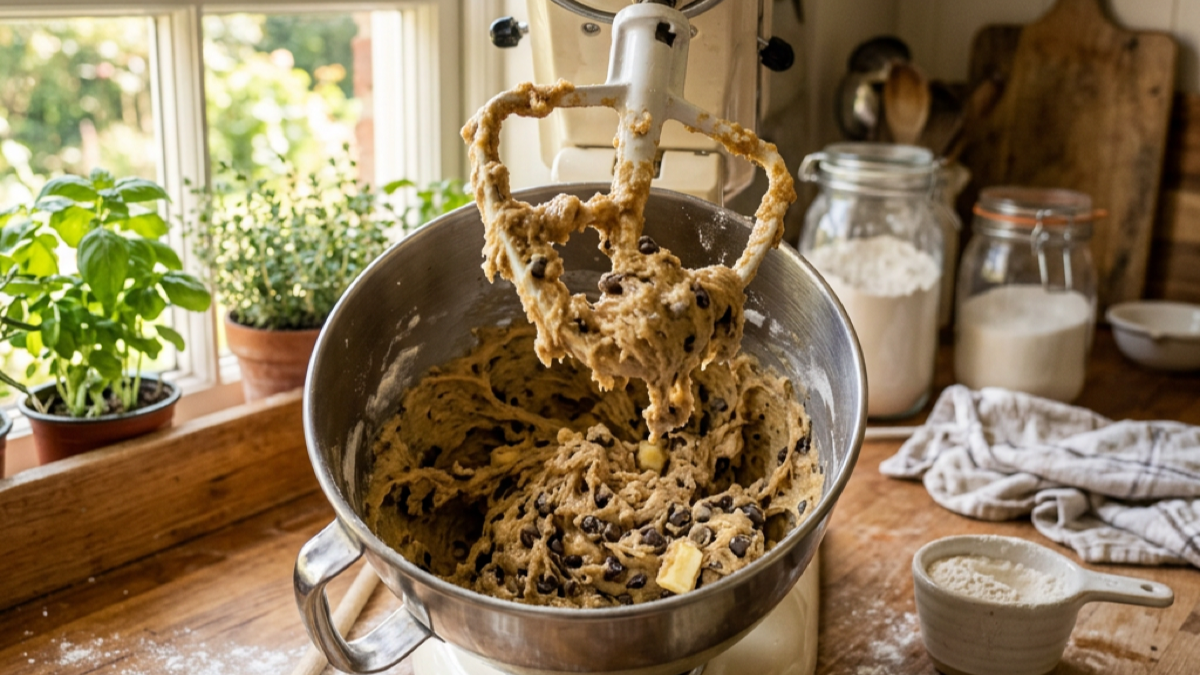
- A paddle attachment — also called a flat beater or flat paddle — is the workhorse attachment that ships with every stand mixer. It's a broad, flat mixing tool used for medium-to-heavy batters: cookie dough, cake batter, mashed potatoes, frosting, meatloaf.
- Paddle vs whisk isn't a preference call. The paddle combines ingredients without adding air. The whisk incorporates air. Use the wrong one and your cake sinks, your buttercream weeps, or your cookie dough turns into a flour cloud.
- Substitutes work in order of preference: hand mixer beaters (closest equivalent), wooden spoon + elbow grease (best for cookies), rubber spatula (batters only). A whisk works only for thin batters — never for cookie dough.
- Coated aluminum paddles peel. The grey film on your hands after a KitchenAid beater goes through the dishwasher is oxidized aluminum. Stainless steel paddles (like the one shipped with the Hauswirt M5max) are dishwasher-safe and never develop this issue.
- Flex edge paddles cost $30 extra and are worth it if you bake weekly. The built-in silicone scraper means you stop every 30 seconds to scrape the bowl — a real time-saver for creaming and thick batters.
Your stand mixer came with three attachments in the box. The whisk is obvious. The dough hook looks like a question mark. Then there's the third one — the flat, paddle-shaped thing with a hole in the middle — and nobody ever tells you what it actually does.
This guide covers what a paddle attachment is, what to make with it, when to swap it for the whisk, what to do if you don't have one, and why the material your paddle is made of matters more than you'd think.
What Is a Paddle Attachment?
A paddle attachment (also called a flat beater or flat paddle) is a broad, flat mixing tool that attaches to the motor head of a stand mixer. As the motor spins, the paddle rotates through the bowl on a planetary path — it traces an orbit around the bowl while also spinning on its own axis. This motion pushes ingredients together rather than whipping air into them.
The paddle is the attachment you'll reach for 70–80% of the time you bake. If a recipe says "beat" or "cream" or "combine" without specifying a tool, default to the paddle.
Paddle vs Whisk vs Dough Hook: The 10-Second Guide
| Attachment | Shape | Job | Use For |
|---|---|---|---|
| Paddle (flat beater) | Flat, oval blade | Combine, cream, mix | Cookies, cake batter, mashed potatoes, frosting, meatloaf |
| Whisk | Looped wire | Incorporate air | Whipped cream, egg whites, meringue, light frostings |
| Dough hook | C-shaped or spiral | Knead gluten | Bread dough, pizza dough, pasta dough |
Simple version: paddle pushes things together, whisk adds air, dough hook develops gluten. Get the attachment right and most recipes get easier.
What to Make with a Paddle Attachment
- Cookie dough — creaming butter and sugar, then folding in flour and mix-ins.
- Cake batter — combining wet and dry ingredients for cakes, muffins, quick breads.
- Mashed potatoes — paddle on low speed breaks down cooked potatoes without turning them gummy (which happens at whip speeds).
- Frosting and buttercream — American buttercream, cream cheese frosting, ganache.
- Meatloaf and meatballs — combining ground meat with binders without overworking the proteins.
- Shredding cooked chicken — paddle on low for 30 seconds shreds a whole breast perfectly.
Paddle vs Whisk: Task-by-Task Breakdown
Most guides say "use the paddle for thick mixtures and the whisk for airy ones." That's true but vague. Here's the specific call for each task:
| Task | Paddle or Whisk? | Why |
|---|---|---|
| Chocolate chip cookies | Paddle | Butter is too stiff for whisk wires to handle. Whisk bends. |
| Sugar cookies, shortbread | Paddle | Same reason — stiff butter, dense dough. |
| Vanilla layer cake | Paddle | You want some air but not meringue-level foam. Paddle on Speed 4-5 creates small, even air pockets. |
| Genoise sponge | Whisk | Genoise relies on whipped whole eggs for lift — paddle can't trap enough air. |
| Pancakes, waffles | Whisk (or paddle on low) | Thin batter; whisk combines faster without overmixing. |
| American buttercream | Paddle | Thick mixture; paddle creams butter and sugar smoothly. |
| Swiss/Italian meringue buttercream | Both — whisk for whites, then paddle to add butter | Whisk whips the meringue; paddle adds butter without deflating. |
| Cheesecake | Paddle | Cream cheese is too thick for a whisk. Paddle on low avoids over-beating (which causes cracks). |
| Whipped cream, meringue | Whisk | Maximum air incorporation. Never use a paddle for these. |
| Mashed potatoes | Paddle | Low-speed breakdown without over-whipping (which turns potatoes gluey). |
One rule covers most of this: if the recipe starts by creaming butter, use the paddle. If it starts by whipping eggs or cream, use the whisk.
Paddle Attachment Substitute: The Honest Hierarchy
You're mid-recipe and your paddle is missing, broken, or in the dishwasher. Here's what works, in order of how close it gets you to the real result:
1. Hand mixer beaters (best substitute)
The standard chrome beaters on a $30 hand mixer do essentially the same job as a stand mixer paddle — they rotate, push ingredients together, and don't incorporate much air.
2. Wooden spoon + elbow grease (best for cookies and thick doughs)
Reddit's r/Baking community recommends this most often. It won't cream butter and sugar as fast as a paddle, but it gets there — usually 4–6 minutes of firm stirring for cookies, vs 2 minutes in a stand mixer. The finished cookie is essentially identical.
3. Rubber or silicone spatula (best for thin batters)
For cake batter, brownie batter, or anything pourable, a spatula folds ingredients together fine. It can't cream butter.
4. Whisk (last resort, with caveats)
A whisk works only for thin batters (pancakes, waffles, quick cakes where butter is melted, not creamed). For anything involving solid butter or stiff cookie dough, the whisk wires bend, the motor strains, and you'll end up with unevenly mixed dough. Don't use a whisk as a paddle substitute for cookies or frosting.
Paddle Materials: Why Yours Might Be Peeling
If your paddle has a grey-white coating that's started chipping off — and your hands come away with a metallic film after handling it — this is the single most common paddle complaint on baking forums, and it has a specific cause.
Most KitchenAid and Cuisinart stand mixers ship with a coated aluminum paddle. The paddle is aluminum (light, cheap) covered in a non-stick coating. But the coating chips — usually first at the sharp edges around the center hub — and once it chips, it continues to flake. Where the coating is gone, bare aluminum reacts with food acids and dishwasher detergent, leaving grey residue on your hands and a metallic taste in delicate batters.
The manufacturer's fix is "hand wash only." Reddit's fix is buying a replacement. The better fix is buying a paddle made of a different material. If you're at the point of replacing a peeling paddle, here's what that looks like in practice:
| Material | Dishwasher safe? | Reactive with food? | Lifespan |
|---|---|---|---|
| Coated aluminum (KitchenAid, Cuisinart standard) | ❌ Hand wash only | Yes — once coating chips | 2–5 years before peeling |
| Stainless steel (Hauswirt standard) | ✅ Yes | No — inert | 15+ years |
| Flex edge / scraper paddle | Varies (most are coated) | Depends on base material | 3–7 years |
Flex edge paddles — also called scraper paddles — add a silicone scraper blade along the edge. They cost $25–$35 extra and eliminate the need to stop and scrape the bowl every 30 seconds during creaming. If you bake weekly, the upgrade pays for itself in time saved within a few months. Most flex edge paddles are still coated aluminum underneath, so they have the same peeling risk as the standard paddle.
Looking for the bread-side companion? See our stand mixer dough hook guide for kneading times, speeds, and the windowpane test. For egg whites, whipped cream, and meringue, see the stand mixer whisk attachment guide.
Frequently Asked Questions
Is the paddle attachment the same as the flat beater?
Yes. "Paddle attachment," "flat beater," and "flat paddle" all refer to the same tool — the broad, flat mixing attachment that comes standard with every stand mixer. KitchenAid calls it a "flat beater" in their manuals; most bakers and recipes call it the "paddle." Same thing.
Can I use a whisk instead of a paddle attachment?
Only for thin batters like pancakes or cakes where butter is melted rather than creamed. For cookie dough, frosting, creaming butter, or mashed potatoes, a whisk will bend, strain the motor, and mix unevenly. A hand mixer with standard beaters is a much closer substitute than a whisk.
What speed should I use with the paddle attachment?
For combining dry ingredients, Speed 1–2. For creaming butter and sugar, Speed 4–5 for 3–5 minutes. For cake batter, Speed 4–6. For mashed potatoes, Speed 2–4 (low speeds avoid over-whipping). Never run the paddle above Speed 7 — it splashes and strains the gearbox without improving the result.
Why is my paddle leaving grey residue on my hands?
Your coated aluminum paddle has started to oxidize where the coating has worn off. The grey film is aluminum oxide — generally safe in small amounts but unpleasant. Hand-washing extends the coating's life, but once peeling starts, the only permanent fix is replacing the paddle with a stainless steel version.
What to Do Next
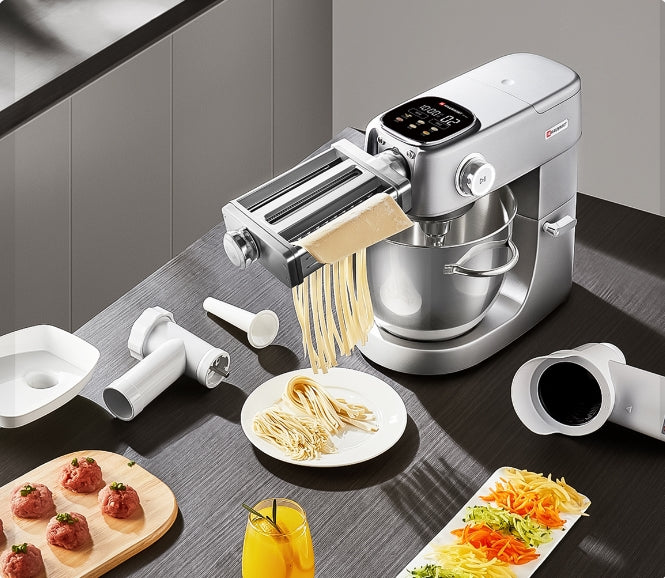
Trying to figure out all your attachments? Our complete stand mixer attachments guide walks through every tool in the box — paddle, whisk, dough hook, plus the power-hub add-ons like pasta rollers and meat grinders.
Confused about what speed to pair with the paddle? Speed and attachment work together. Our stand mixer speed settings guide breaks down exactly which speed to use for each task.
Ready to make something? Start with our stand mixer pie crust guide — it's a perfect first paddle recipe, and the technique transfers to cookies, scones, and biscuits. Or browse our 5 essential stand mixer recipes for a quick-start list.
Sources
- King Arthur Baking — "Which Mixer Attachment Should I Use?" Reference for paddle vs whisk vs dough hook task mapping.
- America's Test Kitchen — Stand mixer attachment testing, including flex edge beater performance benchmarks.
- KitchenAid Official Product Literature — Flat beater specifications and material guidance for coated aluminum attachments.
- Reddit r/Baking community threads on paddle substitutes and coated beater peeling — community-sourced material failure patterns.
- Serious Eats — "The Food Lab's Guide to Stand Mixers" — paddle vs whisk technique analysis.
