


Key Takeaways
- Most stand mixers come with three core attachments — flat beater, dough hook, and wire whisk — that handle 90% of home baking tasks.
- A stand mixer with a DC motor provides more consistent attachment performance under load, especially when running the dough hook on stiff bread dough for 10+ minutes.
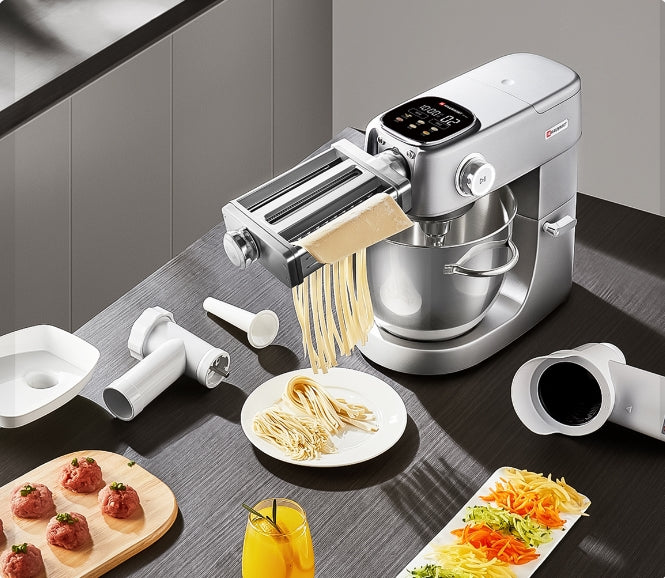
- The noodle-making accessory — a pasta roller and cutter set — ranks as the most popular add-on among experienced bakers. Hauswirt sells three hub attachments in total: noodle making, food chopping, and meat grinding. All three are sold separately from the mixer.
- Not all attachments are universal — hub size, bowl shape, and drive mechanism vary between brands, so compatibility matters more than most buyers realize.
- Which attachment to use depends on the task: flat beater for mixing and creaming, dough hook for kneading, whisk for aerating — using the wrong one is the #1 cause of poor results.
You just unboxed your new stand mixer. Three mystery attachments stare back at you from the foam padding. The manual shows a diagram, but it doesn't explain when to use each one — or why your cookies spread thin every time you use the wrong beater. And then there are the add-ons you keep seeing online — a noodle-making set, a food chopper, a meat grinder — all sold separately from the mixer.
This guide covers every attachment that matters. What each one does. When to reach for it. Which add-ons earn their spot on your counter. And we'll answer the question every new mixer owner asks first: which attachment do I use for this?
The Three Core Attachments (What Came in the Box)
Every stand mixer ships with three standard attachments. If you never buy another one, these three handle the vast majority of what you'll make.
Flat Beater (Paddle Attachment)
The flat beater — also called the paddle attachment — is the wide, flat piece with a slight curve that matches the inside of the mixing bowl. It's the one you'll reach for most often.
For a deeper dive — what to make with it, when to swap it for the whisk, the best substitutes if you don't have one, and why some paddles peel — see our complete stand mixer paddle attachment guide.
What it does: Combines ingredients by pushing them against the bowl wall and folding them back into the mixture. The flat shape creates consistent contact without incorporating too much air.
When to use it:
- Making cookie dough
- Creaming butter and sugar
- Mixing cake batter
- Making brownies and bars
- Combining meatloaf or meatball mixture
- Mashing potatoes (faster and smoother than hand-mashing)
- Mixing frosting and buttercream
Common mistake: Using the flat beater for jobs that need aeration (like whipping cream or egg whites). It won't incorporate enough air, and you'll end up with dense, flat results.
Upgrade worth considering: A flat beater with a silicone edge (sometimes called a flex edge beater) scrapes the bowl as it rotates. This eliminates the need to stop and scrape down the sides every 30 seconds — a real time-saver for thick batters and buttercream. Hauswirt's M5 and M5max both include a flex edge beater standard.
Dough Hook
The dough hook is the C-shaped or spiral-shaped attachment that replaces hand-kneading. It stretches and folds dough to develop gluten — the protein network that gives bread its chew and structure.
What it does: Mimics the push-fold-turn motion of hand kneading. The hook grabs the dough, stretches it against the bowl, and folds it back on itself repeatedly.
When to use it:
- Yeast bread dough (white, whole wheat, sourdough)
- Pizza dough
- Pasta dough
- Brioche and other enriched doughs
- Pretzel dough
- Bagel dough
Spiral vs. C-hook: Two designs exist. The C-hook (the older style) relies on friction between the dough and the bowl wall. The spiral hook rolls the dough through its coils, stretching more efficiently. If your mixer came with a spiral hook, use it — it develops gluten faster and handles stiffer dough with less strain on the motor. For a step-by-step guide to kneading bread dough with your dough hook, including visual cues for when the dough is done, see our complete guide to how to make bread dough in a stand mixer.
The motor matters here. Kneading is the most demanding task for any stand mixer. An AC motor under heavy dough load will slow down, heat up, and sometimes cause the machine to "walk" across the counter. A DC motor maintains consistent RPM and runs cooler — which means your dough hook keeps turning at the right speed, even with 1,500 grams of stiff bread dough. You can hear the difference: an AC motor strain-sounds like it's struggling; a DC motor just keeps going. For more on why motor type affects every attachment's performance, see our stand mixer buying guide.
Want the full breakdown? Read our complete dough hook guide — speed, time, windowpane test, and how to fix dough that climbs the hook.
Wire Whip (Whisk Attachment)
The wire whip — or whisk attachment — is the balloon-shaped tool made of thin metal wires. Its job is aeration: incorporating air into liquids to make them light and fluffy.
What it does: The thin wires cut through liquid ingredients at high speed, trapping air bubbles and increasing volume. The balloon shape maximizes the surface area contacting the mixture.
When to use it:
- Whipping heavy cream to soft or stiff peaks
- Whipping egg whites for meringue
- Making angel food cake
- Making marshmallow or nougat
- Beating eggs for scrambled eggs or omelets
- Whisking salad dressings (if your mixer has a slow enough speed)
Common mistake: Using the whisk for heavy doughs or thick batters. The wires bend under heavy loads, and you'll end up with poorly mixed ingredients and a damaged whisk.
For a deeper dive on speeds, whipping times, and troubleshooting over-whipped cream, see our complete stand mixer whisk attachment guide.
Which Attachment for Which Task — Quick Reference
If you only remember one thing from this guide, make it this table:
| Task | Right Attachment | Why |
|---|---|---|
| Cookies | Flat beater | Combines without over-aerating |
| Cake batter | Flat beater | Even mixing, controlled texture |
| Creaming butter & sugar | Flat beater | Fluffy texture needs mixing, not aeration |
| Bread dough | Dough hook | Develops gluten through stretching |
| Pizza dough | Dough hook | Same as bread — gluten development |
| Pasta dough | Dough hook | Kneads stiff dough to smooth elasticity |
| Whipped cream | Wire whip | Incorporates air for volume |
| Meringue | Wire whip | Maximum aeration for stiff peaks |
| Buttercream frosting | Flat beater | Smooth, dense mixing — not airy |
| Mashed potatoes | Flat beater | Breaks down potatoes smoothly |
| Shredded chicken | Flat beater | Low speed pulls cooked chicken apart |
| Meatloaf mix | Flat beater | Combines without overworking |
| Angel food cake | Wire whip | Needs maximum air incorporation |
Hauswirt Add-On Attachments: What's Worth Buying
Beyond the three standard attachments, your mixer's power hub can drive add-ons. Hauswirt sells three, all sold separately from the mixer: a noodle-making set, a food chopper, and a meat grinder. They are built for the Hauswirt hub and fit the M5, M5max, and M9 only — attachments from KitchenAid, Cuisinart, or any other brand will not mount.
The hub is also the expansion interface for attachments Hauswirt has not released yet — a juicer among them. Nothing beyond the three above is on sale today, so treat any other attachment type as unavailable for a Hauswirt mixer.
The Three Hauswirt Attachments
Pasta Roller and Cutter Set
This is the most recommended add-on attachment across every community and review site we surveyed. A pasta roller flattens dough into sheets of varying thickness, while the cutter attachment slices those sheets into fettuccine, spaghetti, or lasagna noodles.
Why it's worth it: Fresh pasta tastes noticeably different from dried. The roller produces sheets thin enough for ravioli and lasagna — something you can't replicate by hand without a lot of practice. Once you get the hang of it (expect 2-3 batches before it clicks), you can make fresh pasta in about 20 minutes.
Roller vs. press: There are two types of pasta attachments. The roller set flattens and cuts sheets — it's versatile and produces restaurant-quality results. The pasta press (extruder) pushes dough through shaped discs to make penne, bucatini, and macaroni. Reviewers consistently prefer the roller: it's easier to clean, produces better texture, and costs less. The press is fun but harder to use and clean.
Price range: $70–$150 for a roller/cutter set.
Food Grinder (Meat Grinder)
The food grinder attachment feeds meat, cheese, or vegetables through a rotating auger and cutting plate, producing ground output of varying fineness.
Why it's worth it (for the right person): If you grind meat more than once a month — for burgers, meatballs, sausage, or pet food — this attachment pays for itself quickly. Store-bought ground meat costs more per pound, and you control the cut and fat ratio. It also grinds hard cheeses and makes fresh breadcrumbs.
The catch: It's slow compared to a dedicated grinder. If you're processing more than 2-3 pounds at a time, a standalone grinder is a better tool. And cleaning all the parts takes effort — you need to disassemble and hand-wash the auger, blade, and plates.
Price range: $40–$80.
Flex Edge Beater (If Not Included)
If your mixer didn't come with one, a flex edge beater — a flat beater with a silicone scraper along one edge — is the single most useful upgrade for everyday baking.
Why it's worth it: It continuously scrapes the bowl as it mixes, eliminating the stop-scrape-restart cycle. For buttercream, cream cheese frosting, and any thick batter, this saves 3-5 minutes of stopping and scraping per recipe. The silicone edge also prevents flour from accumulating in the bowl crevices.
Price range: $15–$30. If you bake weekly, this pays for itself in saved frustration within a month.

Attachment Compatibility: Will It Fit Your Mixer?
This is the part most attachment guides skip entirely. And it's the reason some buyers end up with attachments they can't use.
Hub Compatibility
Most add-on attachments connect through the power hub — a covered port on the front of the mixer that drives the attachment via a rotating shaft. There are two hub sizes in common use:
| Hub Type | Used By | Attachments Available |
|---|---|---|
| Front hub (≈1.25" opening) | KitchenAid, Cuisinart, Hamilton Beach, and most consumer brands — each with its own proprietary hub geometry | Brand-specific — buy the roller, grinder, or slicer made for your mixer |
| Large hub (≈1.5" opening) | Some commercial models, select Ankarsrum | Fewer options, often requires adapters |
Key point: Hub-mounted attachments are brand-specific. Even when two hubs look similar, the shaft coupling, hub depth, and drive speed are engineered for one brand's mixer — a KitchenAid attachment will not mount on a Hauswirt mixer, and a Hauswirt attachment will not mount on a KitchenAid. Buy the attachments made for your own machine.
Hauswirt's hub doubles as the expansion interface for attachments the company has not released yet — a juicer attachment is the one Hauswirt has provided the port for. It is not on sale, so there is nothing to buy for it today. The released line is three attachments — noodle making, food chopping, and meat grinding — plus replacement beaters, whisks, and dough hooks.
Bowl Attachment Compatibility
The three core attachments (flat beater, dough hook, whisk) are not universal between brands. Each brand designs its attachment-to-bowl geometry specifically for its own bowl shape and planetary mixing action. Using a KitchenAid flat beater in a Hauswirt bowl, or vice versa, can result in:
- Incorrect beater-to-bowl clearance (too close = metal-on-metal scraping; too far = unmixed ingredients)
- Attachments that don't lock into the beater shaft properly
- Voided warranty on both the mixer and the attachment
Rule of thumb: Buy every attachment — core pieces and hub-driven add-ons alike — from your mixer's own brand. Beaters, hooks, and whisks are shaped for one bowl geometry, and hub-driven add-ons such as pasta rollers and grinders are built to one brand's hub. Cross-brand parts either will not mount or will not run correctly.
Beater-to-Bowl Clearance Adjustment
If your flat beater isn't reaching the bottom of the bowl — or it's hitting the bottom with a metallic clang — the clearance needs adjusting. Most mixers have a small screw behind the beater shaft that raises or lowers the attachment point by fractions of a millimeter.
Proper clearance: The beater should pass a dime placed at the bottom of the bowl with slight resistance. If the dime doesn't move, the beater is too high. If the beater scrapes the bowl bottom, it's too low. This takes 30 seconds to adjust and makes a noticeable difference in mixing quality.
Attachment Speed Guide: Which Speed for What
Running the wrong attachment at the wrong speed is the second most common cause of poor baking results (after using the wrong attachment entirely). Here's what each speed range is designed for:
| Speed | Flat Beater | Dough Hook | Wire Whip |
|---|---|---|---|
| 1-2 (Stir/Knead) | Stirring dry into wet, combining meat mixtures | Initial dough mixing, slow kneading | Not recommended |
| 3-4 (Mix/Beat) | Creaming butter and sugar, cake batter, cookie dough | Main kneading speed for most bread dough | Gentle whisking, egg wash |
| 5-6 (Knead/Whip) | Thick batters, frostings | Heavy/stiff dough | Whipping cream to soft peaks |
| 7-8 (Beat/Whip) | Rarely needed | Not recommended | Egg whites, meringue, stiff peaks |
| 9-10 (Fast Whip) | Not recommended | Not recommended | Quick aeration of small volumes |
One important note about speed and motor type: AC motor mixers often struggle to maintain low speeds under load — the dough hook at speed 2 might surge and slow unpredictably. DC motor mixers hold their set speed more consistently, which matters for dough development. Bread recipes specify kneading times assuming a consistent speed; surging produces inconsistent gluten structure.
How to Clean and Maintain Your Attachments
Proper cleaning extends attachment life and prevents cross-contamination — especially important for the food grinder.
Core Attachments (Beater, Hook, Whip)
- Stainless steel: Dishwasher safe on the top rack. However, frequent dishwasher cleaning can dull the finish over time. Hand-washing with warm soapy water is gentler.
- Aluminum: Never put in the dishwasher — it will discolor and pit. Hand-wash only, and dry immediately to prevent water spots.
- Coated/burnished aluminum: Some KitchenAid flat beaters have a non-stick coating. Hand-wash only — the dishwasher strips the coating.
- Wire whip: Hand-wash and dry thoroughly. The wires can trap food particles; use a small brush to clean between them.
Hub-Driven Attachments
- Pasta roller: Never immerse in water. Use the cleaning brush that comes with it, or run a small piece of dough through the rollers to pick up residue, then discard that dough.
- Food grinder: Disassemble completely. Wash all parts in hot soapy water. Dry thoroughly — any moisture left on the cutting blade causes rust. Some owners freeze the parts for 15 minutes before grinding to make cleanup easier (fat solidifies and doesn't stick).
Storage tip: Keep attachments in a dedicated container near your mixer. The three core pieces fit in the bowl when not in use. Hub-driven attachments should be stored in their original boxes or a labeled bin — loose attachments in a drawer get scratched and dented.
5 Surprising Things You Can Do with Standard Attachments
Before you buy more attachments, try these techniques with what you already have:
1. Shred Cooked Chicken in 30 Seconds
Place warm, cooked chicken breasts in the bowl. Attach the flat beater. Run on speed 2 for 30-60 seconds. Perfectly shredded chicken for tacos, salads, or meal prep. This is consistently one of the most-shared stand mixer tips on social media, and it works because the flat beater pulls the chicken fibers apart without pulverizing them.
2. Make Homemade Butter
Pour heavy cream into the bowl. Attach the wire whip. Run on speed 6-7 for 8-12 minutes. The cream goes through stages: whipped cream → over-whipped → separated into butter and buttermilk. Strain through cheesecloth, knead the butter with cold water to remove residual buttermilk, and salt to taste.
3. Fluff Mashed Potatoes Without a Ricer
Boil and drain potatoes. Place them hot in the bowl with the flat beater. Add butter and milk. Mix on speed 2 for 30-45 seconds. The result is smoother than hand-mashing and faster than using a ricer. Stop as soon as they're smooth — over-mixing makes potatoes gummy.
4. Mix Meatballs and Meatloaf Without Getting Your Hands Dirty
Ground meat, breadcrumbs, eggs, seasonings — flat beater on speed 2 for 30-45 seconds. The beater combines everything evenly without overworking the protein (which makes meatballs tough). Your hands stay clean.
5. Make Fresh Pasta Dough from Scratch
Combine flour and eggs in the bowl. Dough hook on speed 2 for 5-8 minutes. The hook kneads the stiff dough to a smooth, elastic ball. You don't need a pasta attachment to make the dough — just to roll it thin. Even without a roller, you can hand-roll dough hook pasta dough into rustic shapes.
Frequently Asked Questions
What's the difference between a flat beater and a paddle attachment?
They're the same thing. "Flat beater" and "paddle attachment" are two names for the same piece. KitchenAid officially calls it a flat beater, but most bakers and recipes refer to it as the paddle. Both terms mean the wide, flat mixing attachment that comes standard with every stand mixer.
Can I use stand mixer attachments in the dishwasher?
It depends on the material. Stainless steel attachments are generally dishwasher safe. Aluminum and coated aluminum attachments should never go in the dishwasher — it damages the surface. Wire whisks can go in the dishwasher but last longer with hand-washing. When in doubt, check the manual or hand-wash.
Are stand mixer attachments universal across brands?
Core attachments (beater, hook, whisk) are not universal — each brand designs them for its own bowl geometry and beater shaft. Using a KitchenAid beater in a Hauswirt mixer or vice versa will likely result in poor mixing performance and could damage the machine. Hub-driven add-ons (pasta roller, grinder) are brand-specific as well — a Hauswirt attachment is built for the Hauswirt hub and will not mount on a KitchenAid mixer, and KitchenAid attachments will not mount on a Hauswirt mixer. Buy attachments made for your own machine.
Which stand mixer attachment should I use for cookie dough?
Use the flat beater (paddle attachment). It combines ingredients evenly without incorporating excess air, which keeps cookies chewy rather than cakey. Start on speed 2 to cream the butter and sugar, then add dry ingredients on stir speed. Never use the whisk for cookie dough — it makes cookies airy and thin.
Do I really need any attachments beyond the three that came with my mixer?
For most home bakers, the three standard attachments handle 90% of baking tasks. The only add-on that most experienced bakers consistently recommend is the pasta roller/cutter set — it produces results you genuinely can't replicate by hand. Everything else depends on how you cook. If you don't grind meat, make pasta, or spiralize vegetables, the three core attachments are all you need.
Why does my stand mixer walk across the counter when using the dough hook?
Walking happens when the mixer vibrates excessively under heavy dough load. This is most common with AC motor tilt-head mixers working on stiff bread dough. Solutions: make sure your mixer is on a non-slip mat, don't exceed the dough capacity for your bowl size, and consider a DC motor mixer — they vibrate significantly less because the motor produces smoother rotational force. Our stand mixer buying guide covers this in more detail.
The Bottom Line
Most people overcomplicate stand mixer attachments. The three that came in the box — flat beater, dough hook, wire whip — are all most home bakers will ever need. Learn which one to use for each task (the table above is worth bookmarking), and you'll get better results than someone who owns every attachment but uses the wrong one.
If you're going to buy one add-on, make it the pasta roller. If you're going to buy two, add the flex edge beater. Everything else depends on how you actually cook, not how you imagine you might cook someday.
And if you're still choosing a mixer, remember: the motor determines how well your attachments perform under pressure. A DC motor keeps the dough hook turning smoothly through stiff bread dough, the flat beater spinning consistently through thick cookie batter, and the whole operation quiet enough to hold a conversation. The attachment matters — but the motor driving it matters just as much. Browse our full stand mixer lineup to see DC motor options, or compare tilt-head and bowl-lift designs in our tilt-head vs bowl-lift guide.
Sources
- America's Test Kitchen, "Stand Mixer Attachment Testing" (2025). Independent lab testing of 12 attachments across performance, durability, and ease of cleaning criteria.
- Reddit r/Baking and r/Cooking community discussions (2024-2026). Aggregated user feedback on attachment value from 50+ discussion threads with 10,000+ combined upvotes.
- NYT Wirecutter, "The Best KitchenAid Attachments" (2025). Hands-on testing of popular add-on attachments with cost-per-use analysis.
- King Arthur Baking Company, "Guide to Stand Mixer Speeds and Attachments" (2024). Technical reference for speed settings and attachment selection by dough type.
- Consumer Reports, "Stand Mixer Reliability and Owner Satisfaction Survey" (2025). Multi-year survey data on motor type, attachment usage frequency, and long-term durability.

