


Key Takeaways
- The KitchenAid Pro 600 is a 6-quart bowl-lift mixer with a 575W AC motor; the Hauswirt M5max is a 6-quart tilt-head with a 500W DC motor.
- Both bowls hold 6 quarts, but the Pro 600 weighs 29 lbs and the M5max weighs about 20 lbs — a 9-pound difference you feel every time you move it.
- Under a stiff dough, the Pro 600 measures roughly 70–80 dB. The M5max measures about 45 dB, closer to a quiet conversation than an appliance.
- The Pro 600 is discontinued — it listed at $599.99, and used units now run roughly $200–260 on eBay. The M5max lists at $399.99, marked down from a $499.99 compare-at price.
- KitchenAid still wins on the powered attachment hub (10+ accessories) and repair access. Hauswirt wins on low-speed torque, noise, and price.
If you knead stiff dough more than once a week, the Hauswirt M5max is the better buy: its 500W DC motor holds speed at the low RPM where bread dough is actually worked, and it runs near 45 dB instead of the Pro 600's 70–80 dB. If you want one machine that also drives a pasta roller, meat grinder, and food processor, a bowl-lift KitchenAid — a used Pro 600, or its KSM60 successor — still makes more sense. And since KitchenAid discontinued the Pro 600, the real question is whether a $399.99 new tilt-head beats a $200–260 used bowl-lift.
For full 6-8 quart capacity math and motor picks, see our best stand mixers for large batches guide.
Both are 6-quart machines aimed at people who bake seriously. That's where the similarities end.
Pro 600 vs M5max: The Specs That Matter
| KitchenAid Pro 600 (KP26M1X) | Hauswirt M5max | |
|---|---|---|
| Design | Bowl-lift | Tilt-head |
| Bowl | 6 quarts, stainless | 6 quarts, stainless |
| Motor | 575W AC, direct-drive | 500W DC |
| Speeds | 10 | 11 + pulse |
| Controls | Mechanical lever | 4.5" touchscreen, knob, 6 presets |
| Weight | 29 lbs | ~20 lbs (9 kg) |
| Noise under load | 70–80 dB | ~45 dB |
| Dough capacity | Up to 8 loaves per batch | 50 oz (about 1.4 kg) |
| Included | Dough hook, flat beater, wire whip, pouring shield | Dough hook, flat beater, wire whip, splash guard |
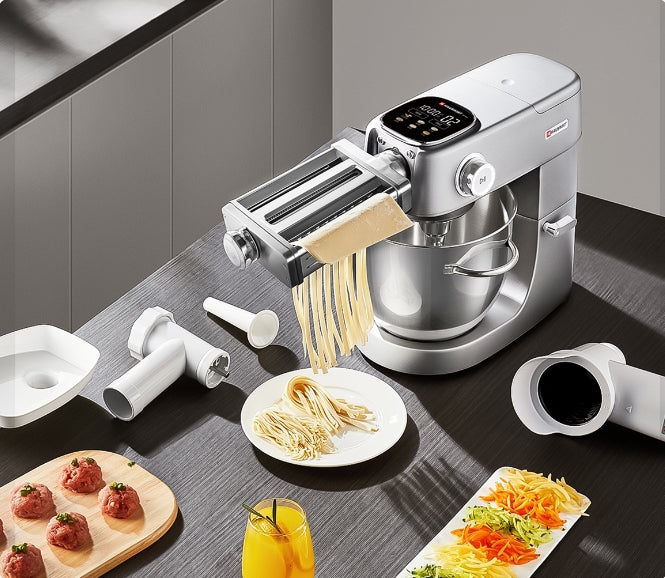
| Powered attachments | 10+ hub accessories | 3 (meat grinder, pasta, slicer) |
| Warranty | 1 year (used units: none) | 12 months + 30-day returns |
| Price | $599.99 list, discontinued; ~$200–260 used | $399.99 (compare at $499.99) |
Read that table twice and one thing stands out: this isn't a new-versus-new comparison anymore. The Pro 600 left KitchenAid's lineup, so you're choosing between a used bowl-lift and a new tilt-head — and the trade-offs that follow from that.
Why Motor Type Decides This Comparison
A DC motor — a permanent-magnet motor that produces high torque at low RPM — is the reason the M5max can knead a stiff dough at speed 1 without bogging down. The Pro 600 uses an AC motor with 75 more rated watts, but AC motors build torque as they spin faster. At kneading speed, most of those 575 watts aren't doing work you can feel.
This is the part spec sheets hide. KitchenAid's own manual tells Pro 600 owners to knead at speed 2 — the slowest setting that won't stall the motor. Hauswirt's DC motor is happiest at exactly that speed. Same instruction, very different experience for the machine doing it.
What it feels like in the bowl
Put 1 kg of 65% hydration dough in both machines and run them at speed 2. The Pro 600's head stays locked because it's a bowl-lift — the bowl rises into the beaters and the head never moves. That's a genuine structural advantage, and it's why bowl-lift mixers are the traditional choice for heavy dough.
But that design has a cost you can hear. The Pro 600's direct-drive gearbox sends every bit of resistance straight into the housing. The machine works. It just tells the whole house about it.
The M5max solves it a different way. The DC motor holds a steady 45 dB, and the tilt-head stays put thanks to a 9 kg cast body and suction-cup feet. Less drama, same dough.
Bowl-Lift vs Tilt-Head: The Trade-Off Nobody Mentions
A bowl-lift mixer raises the bowl into a fixed head with a lever on the side. A tilt-head mixer hinges the head backward so you can reach the bowl from above. Most buying guides frame this as a preference. It isn't — it's a constraint on your kitchen.
Where the bowl-lift wins
Stability under load. The head doesn't move, the bowl locks into a cradle, and the geometry keeps heavy dough centered. If you regularly make three or more loaves at once, this is the design that was built for it.
Access is also better than people expect. The bowl lifts out and sits on the counter, which makes scraping and transferring easier than tilting a head and reaching around a beater.
Where the tilt-head wins
Counter depth and cabinet clearance. A tilt-head needs roughly 8–10 inches behind it for the head to swing back. Under a low upper cabinet, that clearance often doesn't exist — which is how people end up pulling the mixer forward every time they add flour.
A 20-pound machine also gets moved. The M5max is light enough for one person to lift off a shelf; the Pro 600 at 29 pounds is a two-hand, brace-your-core job. If your mixer lives in a cabinet rather than on the counter, that difference matters more than any spec on the box.
Where the Pro 600 Still Wins
Three places, and none of them are small. Worth saying up front, too: discontinued doesn't mean rare. The Pro 600 sold for well over a decade, used units are all over eBay in the $200–260 range, and KitchenAid sells refurbs directly on its own site. This machine is still very much in play.
The attachment hub. KitchenAid's front hub drives more than ten powered accessories — pasta rollers and cutters, meat grinders, spiralizers, food processors, grain mills, ice cream bowls. The M5max offers three. If you want one machine that also makes pasta and grinds meat, this is the deciding factor and it isn't close.
Repair and parts. Every small-appliance shop in the country can service a KitchenAid. Replacement gears, hooks, and bowls are cheap and everywhere. The M5max's sealed DC motor isn't designed for DIY repair, so a failure outside warranty most likely means replacement.
Resale. A used Pro 600 holds value because the buyer already knows what it is. That matters if you might upgrade in three years.
One honest counterpoint: longtime KitchenAid owners on r/BuyItForLife and r/Kitchenaid frequently argue the newer units don't feel as solid as the Hobart-era machines. That's a real sentiment in the community, not a knock we invented. The Pro 600 is still a durable mixer — it's just no longer the obvious default it was in 1995.

Hauswirt M5 Max 6QT Stand Mixer for Effortless Home Baking
500W DC Motor | 6QT Bowl | 45dB Quiet | 4.5" Touchscreen
Who Should Buy Which
Buy a used Pro 600 if you're comfortable buying secondhand, you knead very large batches on a schedule, and the attachment hub matters. At $200–260 used it's the cheapest serious dough machine around — you're trading warranty and quiet for capacity and ecosystem. If you want a bowl-lift with a warranty, the KSM60 successor is the new-production equivalent.
Buy the M5max if bread and pizza are the point and you want a new machine with a warranty. The DC motor is the better tool for stiff dough at low speed, it's about 30 dB quieter, it weighs 9 pounds less, and at $399.99 new it undercuts the KSM60's street price.
There's a third answer worth saying out loud: if you mostly make cakes, cookies, and frosting, neither machine is necessary. A 5-quart tilt-head does that work fine for less money. These two are worth comparing because dough is in your rotation.
Frequently Asked Questions
Is the KitchenAid Pro 600 discontinued?
Yes. KitchenAid retired the Pro 600 (KP26M1X) and moved its 6-quart bowl-lift slot to newer models like the KSM60. You can still find the Pro 600 refurbished on KitchenAid's own site and used on eBay for roughly $200–260, which is why it still shows up in so many comparisons.
What replaced the KitchenAid Pro 600?
The KSM60 — a 6-quart, 11-speed bowl-lift that ships with a Flex Edge beater and typically sells in the low-to-mid $300s at warehouse clubs, higher elsewhere. It keeps the same powered attachment hub and bowl-lift geometry with a slightly updated motor and controls.
Is a used Pro 600 worth it over a new M5max?
If you knead big batches and want the attachment ecosystem, yes — $200–260 for a proven 6-quart bowl-lift is a strong deal, and parts are cheap if it needs work. If you want a warranty, quieter kneading, and lower dough-heat, the new M5max at $399.99 is the safer purchase. Used means no warranty; that's the core trade.
Can the M5max handle the same dough as a Pro 600?
It handles 50 ounces of dough per batch, which covers a standard two-loaf recipe with room to spare. The Pro 600 is rated for larger batches and its bowl-lift design is sturdier under that load. For weekly home baking, both are enough. For commercial-style volume, the bowl-lift geometry is the safer choice.
Why is the Pro 600 so loud?
It uses an AC motor with a direct-drive gearbox, so gear noise and motor whine travel straight into the housing. Measurements typically land around 70–80 dB under a stiff dough — roughly vacuum-cleaner territory. The M5max's DC motor measures near 45 dB on the same task.
Does a tilt-head need more counter clearance than a bowl-lift?
Yes. A tilt-head needs 8–10 inches of space behind it for the head to hinge back, which is why low upper cabinets cause problems. A bowl-lift keeps a fixed footprint and lifts the bowl instead, so it can slide closer to the wall.
Can I use KitchenAid attachments on the Hauswirt M5max?
No. KitchenAid attachments use a proprietary hub that doesn't fit Hauswirt machines, and Hauswirt's own accessories don't fit KitchenAid. The two ecosystems are separate, so if you already own KitchenAid attachments, switching means replacing them.
Which one is easier to repair?
The Pro 600, by a wide margin. Parts are inexpensive and widely stocked, and most repairs are documented in tutorials you can follow at home. The M5max's DC motor unit is sealed and not intended for DIY service, so warranty coverage is the main path if something fails.
Related Reading
This article is part of our Hauswirt vs KitchenAid Stand Mixer comparison series — the brand-level breakdown of motors, noise, attachments, and price.
What to Do Next
If you're still weighing tilt-head against bowl-lift as a design choice, our tilt-head vs bowl-lift breakdown covers clearance, weight, and batch size in more detail. Comparing the smaller KitchenAid? Read KitchenAid Artisan vs Hauswirt M5max instead.
To see the DC motor difference in practice, look at the Hauswirt M5max, or browse the full stand mixer collection to compare the M5, M5max, and M9 side by side.
Sources
- KitchenAid US, "Professional 600 Series 6 Quart Bowl-Lift Stand Mixer (KP26M1X)" — official specs: 575W motor, 6-quart bowl, 10 speeds, bowl-lift design; product line since discontinued, refurbished units sold on kitchenaid.com.
- eBay sold listings and Camelcamelcamel price history for KP26M1X — used-market pricing of roughly $200–260 against a $599.99 original list.
- Hauswirt.com, "Hauswirt M5 Max 6QT Stand Mixer" — official specs: 500W DC motor, 6-quart bowl, 11 speeds plus pulse, 4.5-inch touchscreen, 9 kg metal body, 50 oz dough capacity, $399.99 list.
- America's Test Kitchen, "The Best Stand Mixers" — comparative testing on kneading performance, noise, and bowl-lift vs tilt-head usability.
- Reddit r/BuyItForLife and r/Kitchenaid — owner discussion on stiff-dough performance, durability, and build quality across KitchenAid generations.
- Wirecutter (The New York Times), "The Best Stand Mixers" — third-party context on price tiers and what the money actually buys.

