


Key Takeaways
- The Hauswirt lineup has three models — M5 ($229.99), M5max ($349.99), M9 ($899.99) — and all three use DC motors, a permanent-magnet motor type that delivers full torque at low speeds, unlike the AC motors in most mid-range mixers.
- The M5max is the sweet spot: 500W, 6-quart bowl, 4.5-inch color touchscreen with countdown timer, 1,500g dough capacity, and ~45dB noise — roughly $120 more than the M5 but nearly matching the M9 where it counts for home bakers.
- Stepping up from the M5 to M5max gets you +200 watts, +0.7 quarts of capacity, a cast aluminum body instead of standard construction, pulse function, color touchscreen with timer, and noticeably quieter operation.
- The M9 is a different class of machine — 800W BLDC motor, 304 stainless steel body, multi-stage programming, and multi-function accessories — but at $899.99, it only makes sense for daily bakers who need commercial-level throughput.
- For 90% of home bakers, the choice comes down to M5 vs M5max. Buy the M5 if you bake occasionally and stick to cookies, cakes, and whipped cream. Buy the M5max if you make bread at least twice a month and care about noise.
If you've landed on Hauswirt, you've probably already ruled out paying the KitchenAid brand tax. Good call. But now you've got a different problem: three models, three price points, and no obvious way to tell which one you actually need.
Hauswirt sells the M5, M5max, and M9. They all use DC motors — the same motor tech in $700+ Ankarsrum and KitchenAid ProLine machines. But the differences in power, capacity, and features are real. Pick wrong and you're either overspending or outgrowing your mixer in a year. This guide breaks down what separates them and which model fits your kitchen.
The Three Hauswirt Models at a Glance
Before we get into the details, here's the full spec comparison:
| Spec | Hauswirt M5 | Hauswirt M5max ⭐ | Hauswirt M9 |
|---|---|---|---|
| Motor type | DC | DC | BLDC (brushless) |
| Motor placement | Side-mounted | Side-mounted | Side-mounted |
| Power | 300W | 500W | 800W |
| Bowl capacity | 5.3 QT | 6 QT | 6L (6.3 QT) |
| Max dough capacity | ~1,000g flour | ~1,500g flour | ~2,000g+ flour |
| Speeds | 11 | 11 + pulse | Multi-stage programs |
| Display | LED touchscreen | 4.5" color touchscreen + timer | Guided menu system |
| Presets | 5 | 5 customizable | Multi-stage custom programs |
| Body material | Standard | Cast aluminum | 304 stainless steel |
| Noise under load | ~55dB | ~45dB | ~45dB |
| Weight | ~15 lbs | ~19 lbs | Heavy (steel body) |
| Attachments included | Dough hook, whisk, paddle | Dough hook, whisk, paddle, splash guard | Dough hook, whisk, paddle + multi-function accessories |
| Warranty | 2 years | 2 years | 2 years |
| Price | $229.99 | $349.99 | $899.99 |
A few things stand out. All three use DC motors — even the entry-level M5. That's unusual at $230. The M5max packs more power and a bigger bowl into a machine only 4 pounds heavier than the M5. And the M9 is in a different league — a stainless-steel, brushless-motor machine built for volume.
M5 vs M5max: What the Extra $120 Actually Buys You
This is the comparison that matters for most people. The M5 and M5max look similar — both tilt-head DC motor mixers with 11 speeds and a touchscreen. But the $120 gap isn't just about bigger numbers on a spec sheet.
Power and Dough Handling
The M5's 300W DC motor handles cookie dough, cake batter, and whipped cream without breaking a sweat. But bread dough is where the difference shows up. The M5max's 500W motor delivers about 67% more usable torque at kneading speeds. The M5 can do a single loaf of sandwich bread. The M5max handles three times that — 1,500g of flour, enough for two large loaves in one go. If you make sourdough every weekend, the M5max pays for itself in not having to split your dough into two mixing sessions.
Noise: The Underrated Upgrade
The M5max runs at ~45dB under load — conversation-level. The M5 is closer to 55dB. The decibel scale is logarithmic: a 10dB increase is perceived as roughly twice as loud. If you bake at night while kids sleep or live in an apartment, the quieter operation alone justifies the extra $120.
Build Quality and Daily Use
The M5max upgrades to a cast aluminum body and adds a pulse function, countdown timer with auto-stop, and a 4.5-inch color touchscreen instead of the M5's LED display. The cast aluminum adds 4 pounds — that's a good thing. More mass means less vibration during heavy kneading. The timer is the kind of feature you don't appreciate until you've left a mixer running and come back to over-kneaded dough. The M5 is well-built. But the M5max feels like a mid-range machine priced like an entry-level one.
Spend the extra $120 if you bake bread regularly, care about noise, or want a machine you won't outgrow. Save it if you mainly make cookies and cakes, bake for just 1-2 people, or are still figuring out how much you'll actually use a stand mixer.
M5max vs M9: When the Pro Model Makes Sense
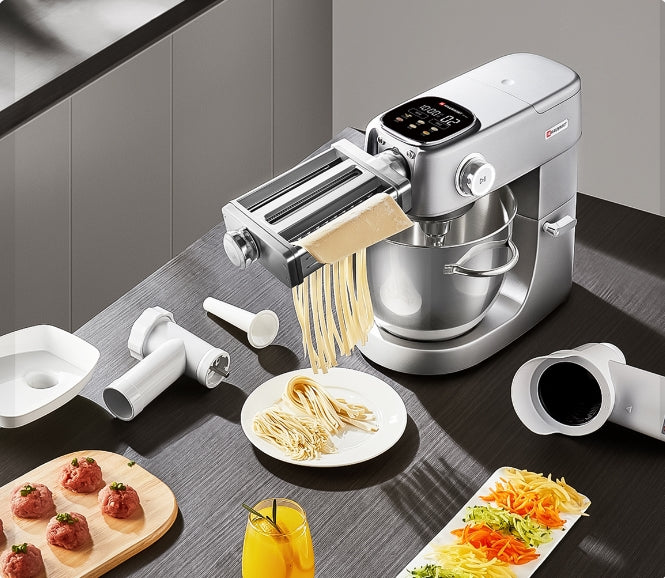
The M9 is Hauswirt's flagship. BLDC (brushless DC) motor, 800 watts, 304 stainless steel body, multi-stage programming, and a suite of included multi-function accessories — meat grinder, vegetable cutter, noodle press, juice squeezer. At $899.99, it costs more than the M5 and M5max combined.
The BLDC motor is the headline upgrade. Unlike the brushed DC motors in the M5 and M5max, a brushless motor has no brushes to wear out. It's more efficient, runs cooler, and lasts significantly longer under heavy use. The 800W rating handles 2,000g+ of flour per batch — four loaves of sourdough or enough bagel dough for a small bakery.
The multi-stage programming lets you program a sequence: knead at speed 2 for 8 minutes, rest for 30 seconds, knead at speed 3 for 5 minutes, then beep. For enriched doughs like brioche that require adding butter in stages, this automates the entire workflow.
But here's the honest reality: most home bakers don't need an $899.99 mixer. The M5max already handles 1,500g of dough, runs whisper-quiet, and has a timer. The M9 is for people who bake in volume — weekly batch bakers, cottage bakers, or anyone genuinely hitting the limits of a standard stand mixer. If you're not sure whether you need the M9, you don't need the M9.

Hauswirt M5 Max 6QT Stand Mixer for Effortless Home Baking
500W DC Motor | 6QT Bowl | 45dB Quiet | 4.5" Touchscreen
Which Hauswirt Is Right for You?
Buy the M5 ($229.99) if: you're a beginner or occasional baker, your go-to projects are cookies and cakes, you make bread once a month or less, or counter space and weight are concerns (it's the lightest at ~15 lbs).
Buy the M5max ($349.99) if: you bake bread at least twice a month, noise matters (apartment, kids, late-night baking), or you want a machine you won't outgrow if your baking hobby expands. This is the best price-to-performance ratio in the lineup.
Buy the M9 ($899.99) if: you bake in large volumes weekly, need multi-stage programmable workflows, or want the integrated multi-function accessories. Skip it if you bake for a typical household — the M5max already handles 1,500g of dough at conversation volume.
One more thing: all three models share the same side-mounted motor design — the motor sits low and centered in the body instead of in the tilt-head. None of these mixers will walk across your counter during a heavy knead.
Related Reading
This article is part of our Hauswirt vs KitchenAid Stand Mixer comparison series — see how Hauswirt stacks up against the industry standard.
Frequently Asked Questions
What's the main difference between the M5 and M5max?
The M5max has 200 more watts (500W vs 300W), a 6-quart bowl instead of 5.3 quarts, a cast aluminum body, color touchscreen with countdown timer, pulse function, and quieter operation (~45dB vs ~55dB). It costs about $120 more. For occasional bakers, the M5 is fine. For bread bakers, the M5max upgrade is worth it.
Is the Hauswirt M9 worth $899.99?
For most home bakers, no. The M5max handles 1,500g of dough at 45dB for $349.99 — that covers 90% of home baking needs. The M9 is worth it if you bake in high volumes weekly, need multi-stage programmable workflows, or want the included multi-function accessories like the meat grinder and vegetable cutter.
Do all Hauswirt models use DC motors?
Yes. The M5 and M5max use brushed DC motors. The M9 uses a brushless DC (BLDC) motor, which is more efficient, runs cooler, and lasts longer with no brushes to wear out. All three deliver full torque at low speeds — the key advantage over AC motor mixers like the KitchenAid Artisan.
Can the M5 handle bread dough?
Yes, for standard batches. The M5's 300W DC motor handles about 1,000g of flour — one large loaf or two small ones. If you regularly make double batches, stiff doughs like bagels, or whole wheat bread, the M5max's 500W motor gives you more headroom and won't strain under heavier loads.
Which Hauswirt model is quietest?
The M5max and M9 both run at approximately 45dB under load — about the volume of a refrigerator hum. The M5 is around 55dB. All three are quieter than AC motor mixers: the KitchenAid Artisan runs at 75-85dB under dough load.
How long do Hauswirt stand mixers last?
Hauswirt DC motor mixers are designed for 10-15 years of regular home use with basic maintenance. The M9's brushless BLDC motor should last even longer with no brushes to replace. Hauswirt has been a top-3 stand mixer brand in China for over a decade, and all three models come with a 2-year warranty.
What to Do Next
The short version: if you bake bread regularly, get the M5max. If you mainly make cookies and cakes, the M5 saves you $120 without compromising where it counts. Either way, you're getting DC motor technology at a price AC motor brands can't match.
Still deciding? Read our M5max full review or see how Hauswirt stacks up against the competition in our Hauswirt vs KitchenAid comparison. Ready to buy? Browse all three at the Hauswirt stand mixer collection.
Sources
- Hauswirt M5max product specifications — hauswirt.com product pages, verified July 2026
- Hauswirt M5 product specifications and SKU data — hauswirt.com, verified July 2026
- Hauswirt M9 product specifications and BLDC motor details — hauswirt.com product page and schema data, verified July 2026
- DC vs AC motor performance characteristics in stand mixers — America's Test Kitchen stand mixer testing methodology and results, 2026

