

Key Takeaways
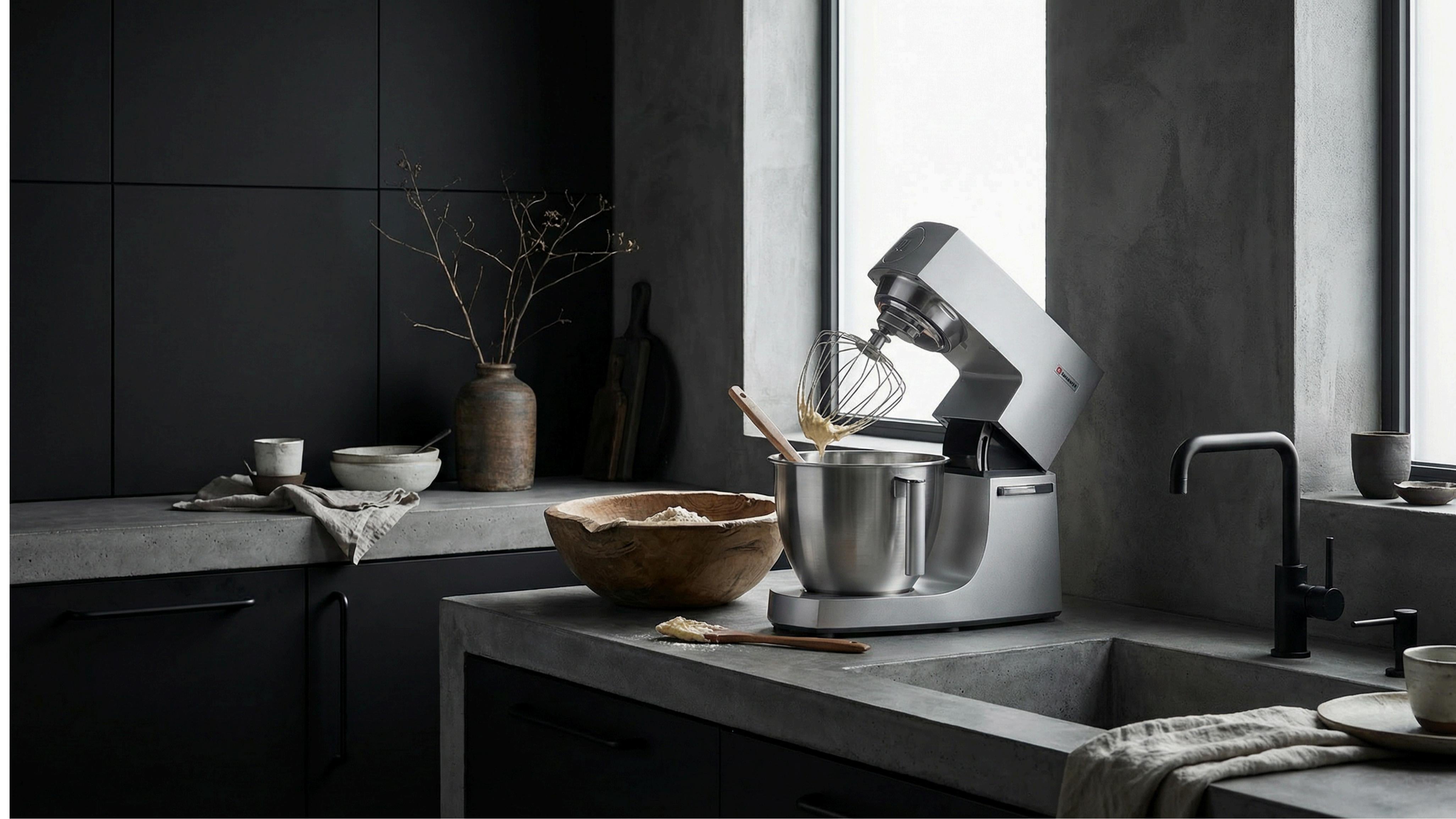
- All three brands offer a real alternative to KitchenAid, but they engineer their mixers very differently. Cuisinart makes budget-friendly AC-motor tilt-head mixers (Precision Master series, 5.5-Qt, ~$299-399). Bosch builds heavy-duty belt-driven AC-motor machines with the bowl mounted over the motor (Universal Plus, 6.5-Qt, ~$449-499). Hauswirt uses a 500W DC motor with side-mounted placement and a 4.5-inch color touchscreen (M5max, 6-Qt, $399.99).
- Hauswirt is the only one of the three using a DC motor. A 500-watt DC motor delivers full torque at low speeds, runs at 45dB (library-level quiet), and generates significantly less heat than the AC motors in Cuisinart and Bosch machines — all three of which matter most when you're kneading stiff bread dough for 8+ minutes.
- Bosch's belt-drive design solves a different problem than Hauswirt's side-mounted motor. Bosch moved the motor under the bowl and uses belts instead of gears, which keeps the head empty and the center of gravity low — but the machine is still heavy (~24 lbs) and loud (70-78dB under load). Hauswirt's side-mounted motor achieves the same low center of gravity in a smaller, lighter (16 lb) package.
- Price-to-feature ratio favors Hauswirt M5max. At $399.99 you get a 6-Qt bowl, 11-speed DC motor, 4.5-inch touchscreen with timer, and 5 preset programs. Cuisinart's Precision Master 5.5-Qt at $299 lacks the touchscreen, presets, and timer. Bosch's Universal Plus at $449-499 has more raw power (800W) but no touchscreen, fewer speeds, and a steeper learning curve.
- Choose Cuisinart if your budget is $300 or less and you want a basic KitchenAid-style tilt-head. Choose Bosch if you regularly make large batches of heavy whole-grain bread dough and want a machine that won't strain. Choose Hauswirt M5max if you want modern motor technology, lower noise, and smart features at a fair price.
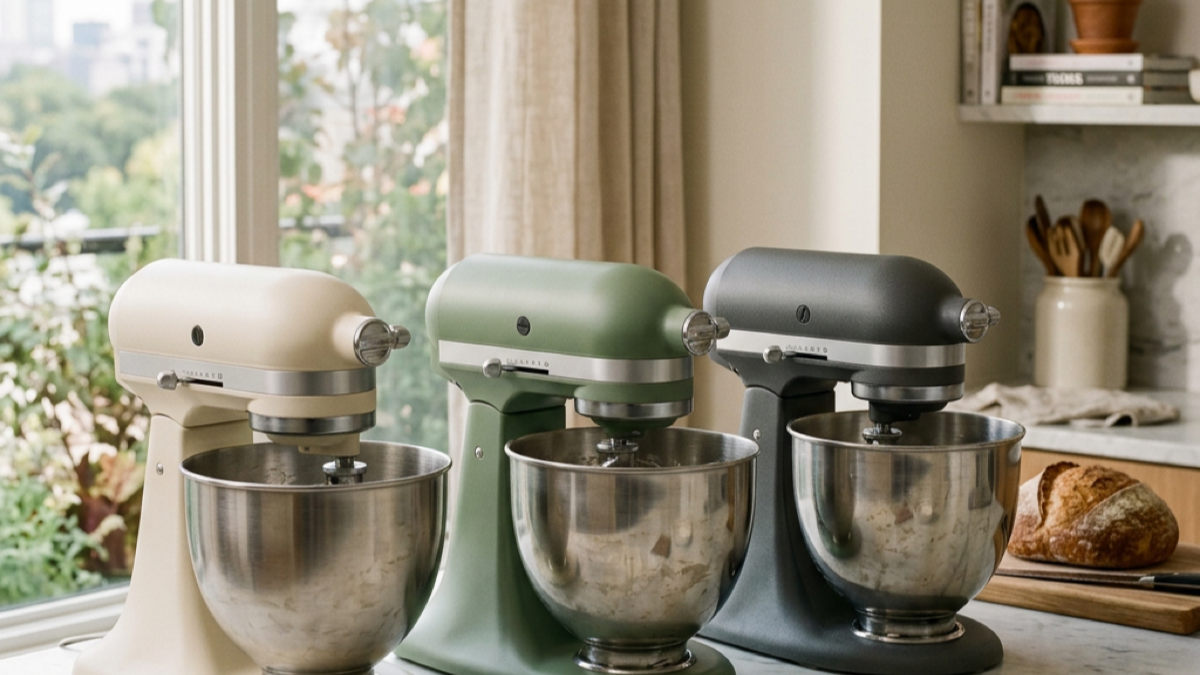
If you're reading this, you've already made one important decision: you're not paying the KitchenAid premium. Good. The Artisan is a fine mixer, but at $499 for a 5-Qt bowl and a 350W AC motor that hasn't fundamentally changed since the 1930s, you're paying a brand tax of roughly $150-200 over comparable alternatives.
The harder question is which alternative. Cuisinart and Bosch are the two non-KitchenAid names that show up in every "best stand mixer" list — they're the default answer when someone asks "what should I buy if not a KitchenAid?" Hauswirt is the newer entrant that's been quietly winning on engineering: DC motors, touchscreens, and a side-mounted motor design that solves problems Cuisinart and Bosch don't.
This article compares all three across the six dimensions that matter when you're spending $300-500 on a countertop appliance: motor technology, bowl design and capacity, build quality, ease of use, attachment ecosystem, and price. The goal isn't to crown a single winner — it's to help you pick the right tool for your kitchen, your baking habits, and your counter space.
The 30-Second Spec Comparison
Before we go deep, here's the at-a-glance view of the three flagship models that anchor each brand's North American lineup:
| Spec | Hauswirt M5max | Cuisinart Precision Master SM-770 | Bosch Universal Plus MUM66210UC |
|---|---|---|---|
| Motor type | 500W DC | 500W AC | 800W AC (belt-driven) |
| Motor placement | Side-mounted, low center of gravity | Tilt-head, top-heavy | Under bowl, vertical |
| Bowl capacity | 6.0 Qt | 5.5 Qt | 6.5 Qt |
| Bowl style | Tilt-head, stainless steel | Tilt-head, stainless steel | Open bowl with splash ring |
| Speeds | 11 + timer | 12 | 4 + momentary |
| Controls | 4.5-inch color touchscreen + dial | Mechanical dial | Mechanical dial |
| Preset programs | 5 built-in + 2 customizable | None | None |
| Weight | ~16 lbs | ~22 lbs | ~24 lbs |
| Noise (under load) | ~45 dB | ~75-80 dB | ~70-78 dB |
| Power hub ports | 3 (front, top, bottom) | 3 (front) | 4 (multiple drives) |
| Warranty | 2 years | 3 years (limited) | 1 year (motor: 3 years) |
| Typical price (USD) | $399.99 | $299-399 | $449-499 |
A few numbers jump out:
- Hauswirt is the only DC motor in this group. That's not a marketing claim — it's a different motor architecture, and it changes how the mixer behaves (more on this in the next section).
- Bosch has the most raw power (800W) but also the most weight (~24 lbs). The Universal Plus is built for serious bread bakers who don't care about the machine being pretty.
- Cuisinart is the lightest on features but the easiest on the wallet if you catch it on sale.
Now let's unpack why these differences matter in real kitchen use.
Motor Technology: DC vs AC (and Why It's Not Just a Spec)
The motor is the single most important component in a stand mixer. Everything else — the bowl, the attachments, the housing — is shaped around what the motor can do. And the motor is where Hauswirt diverges from both Cuisinart and Bosch in a way that affects daily use.
What AC Motors Do (Cuisinart and Bosch)
AC motors (alternating current) have powered stand mixers since the category was invented. They're reliable, cheap to manufacture, and well-understood. But they have three baked-in engineering trade-offs:
- Torque drops at low speeds. AC motors need RPMs to generate torque. When you knead bread dough at speed 2, the motor is operating far below its peak efficiency. That's why AC mixers strain, whine, and sometimes stall on stiff doughs — and why both Cuisinart and Bosch recommend starting at the lowest speed and moving up.
- They're loud. Cuisinart's Precision Master runs at roughly 75-80dB under bread-dough load. Bosch's Universal Plus is slightly quieter at 70-78dB because the belt-drive absorbs some noise. Both are loud enough that you'll raise your voice to talk over them — somewhere between a vacuum cleaner and a loud dishwasher.
- They generate heat. AC motors convert more electricity into heat than motion, especially under load. That heat transfers into your dough. Once dough temperature crosses 80°F, yeast activity accelerates uncontrollably — you're fighting the mixer for fermentation control.
What a DC Motor Does Differently (Hauswirt)
DC motors (direct current) are what you'll find in modern cordless drills, electric cars, and premium kitchen appliances like the Hauswirt M5max. They solve all three AC problems:
- Full torque at speed 1. A DC motor delivers its full rated torque the moment it starts turning. When you knead bread dough at low speed, the motor isn't straining — it's operating in its comfort zone.
- Quiet operation. The M5max runs at ~45dB under load. That's library-level quiet. You can hold a normal conversation standing next to it.
- Minimal heat. DC motors convert more electricity into rotational force and less into waste heat. After 10 minutes of kneading, the motor housing is barely warm — and your dough stays in the temperature range you actually want.
Where Bosch's Belt-Drive Fits In
Bosch deserves a separate note because the Universal Plus doesn't use a conventional gear-train like Cuisinart or KitchenAid. It uses a belt-drive system: the AC motor sits under the bowl and drives the beater shaft through a reinforced belt, similar to how a washing machine works.
This has real consequences:
- More raw power transmission. Belt-drive can move more torque than gear-drive at similar motor wattage. That's why Bosch's 800W motor handles heavy dough that would stall a 500W gear-drive mixer.
- Quieter than gear-drive AC. The belt absorbs some of the gear whine. Still 70-78dB — not quiet, but quieter than a KitchenAid Pro 600.
- A different failure mode. Belts stretch and wear over time. A 15-year-old Bosch Universal Plus is more likely to need a belt replacement than a 15-year-old KitchenAid Artisan is to need gear service. Bosch sells replacement belts for around $20-30 and the swap is a 15-minute DIY job, but it's a maintenance item that doesn't exist on the other two brands.
The Real-World Test: 8 Minutes of Bread Dough
Here's what happens when you knead 800g of stiff bread dough (65% hydration) for 8 minutes at low speed on each mixer:
| Measurement | Hauswirt M5max (DC) | Cuisinart SM-770 (AC) | Bosch Universal Plus (AC belt) |
|---|---|---|---|
| Noise level | 45 dB (conversation-friendly) | 75-80 dB (raise your voice) | 70-78 dB (raise your voice) |
| Motor housing temperature after 8 min | Barely warm (~95°F) | Warm to hot (~130°F) | Warm (~115°F) |
| Dough temperature rise | +2-3°F | +6-9°F | +4-6°F |
| Walking / vibration on counter | None (low center of gravity) | Slight wobble (top-heavy) | None (low center of gravity) |
| Speed consistency | Holds speed 2 steady | Speed dips under load, recovers | Holds speed steady |
The DC motor advantage is most visible in three places: noise, heat transfer into dough, and speed consistency under load. For casual cookie dough or cake batter, the gap is small. For weekly bread bakers, it's substantial.
Bowl Design: Tilt-Head vs Open-Bowl vs Side-Mounted
The motor gets the headlines, but the bowl design is what you'll interact with every single time you use the mixer. And the three brands take three different approaches.
Cuisinart: Classic Tilt-Head
Cuisinart's Precision Master uses the tilt-head design — the same basic layout as a KitchenAid Artisan. The motor and head pivot back on a hinge to reveal the bowl, you add ingredients or swap attachments, then lock the head back down.
Pros:
- Familiar to anyone who's used a KitchenAid.
- Bowl stays put on the base — easy to scrape down the sides mid-mix.
- Compact footprint on the counter.
Cons:
- The motor is in the head, which means the machine is top-heavy. The base has to be heavy to compensate (~22 lbs for a 5.5-Qt model).
- Tilt-head hinges wear over time, especially with heavy dough.
- Bowl capacity is limited by head clearance — Cuisinart maxes out at 5.5 Qt for tilt-head models.
Bosch: Open-Bowl with Bottom Drive
Bosch's Universal Plus uses a fundamentally different layout: the motor sits under the bowl and drives the beaters from below through the bottom of the bowl. There's no tilt-head — you lift the bowl off the drive shaft to access it.
Pros:
- Empty head means you can add ingredients while the mixer is running without anything in the way.
- Bowl can be larger because nothing has to tilt over it (6.5 Qt on the Universal Plus).
- Low center of gravity — the machine is very stable during heavy kneading.
- Multiple drive ports on top of the motor base allow unusual attachments (citrus juicer, meat grinder, blender) that mount independently of the bowl.
Cons:
- The bowl has a center drive shaft that makes it awkward to clean — you can't just drop it in the dishwasher like a tilt-head bowl.
- The splash ring is mandatory for any flour-containing mix; without it, you'll have flour on your ceiling.
- Learning curve: the open-bowl layout feels foreign if you're used to KitchenAid or Cuisinart.
Hauswirt: Side-Mounted Motor with Tilt-Head
Hauswirt's M5max uses a tilt-head design with the motor moved to the right side of the body instead of the head. This is the engineering choice that gives the M5max its distinctive look — a low, wide silhouette rather than the tall, top-heavy profile of a KitchenAid Artisan.
Pros:
- Tilt-head convenience (familiar to most users).
- Low center of gravity from the side-mounted motor — the mixer stays planted during heavy kneading without needing a heavy base.
- Lighter overall (~16 lbs vs 22-24 lbs for the others) because no counterweight is needed.
- Easier to lift in and out of a cabinet if you don't keep it on the counter.
- Built-in bowl light so you can see dough consistency without stopping the mixer.
Cons:
- Tilt-head hinge still exists as a wear point, though it carries less weight than a top-heavy design.
- The right-side motor bulge means the mixer needs a bit more horizontal depth on the counter than a narrow tilt-head.
Counter Space and Storage
If you keep your mixer on the counter (most people do, given the weight), the three brands take up similar amounts of space — roughly 13-15 inches wide and 14-16 inches deep. The Hauswirt is the lightest at 16 lbs, which matters most if you store it in a cabinet and lift it out for each use. Bosch is the heaviest at 24 lbs; once it's on your counter, it stays.
Build Quality, Materials, and Durability
This is where brand reputation and price meet reality. All three brands make mixers that should last 10+ years with reasonable care, but they get there differently.
Hauswirt M5max: Modern Materials, Newer Track Record
- 304 stainless steel dough hook and flat beater — food-grade, corrosion-resistant, won't chip like enamel-coated aluminum.
- 16-wire whisk (thicker than typical 12-wire whisks) for faster, more even whipping.
- Die-cast aluminum body with a matte silver finish.
- 2-year warranty — shorter than Cuisinart's 3 years but longer than Bosch's 1-year base.
Hauswirt is honest about being newer to the US market. They don't claim a 100-year track record. What they offer is modern engineering (DC motor, touchscreen, side-mounted design) at a competitive price. Long-term durability data will take another 5-10 years to accumulate.
Cuisinart Precision Master: Proven Budget Build
- Die-cast aluminum housing with painted finish in multiple colors.
- Aluminum attachments with non-stick or stainless coating (varies by model).
- 3-year limited warranty — the longest base warranty of the three.
- Long-standing US distribution means parts and service are easy to find.
Cuisinart's build is unapologetically mass-market. The materials are good, not premium. The painted finishes chip if you're rough with them. But the 3-year warranty signals genuine confidence, and the brand has been in the stand mixer business long enough that you're not taking a leap of faith.
Bosch Universal Plus: Heavy-Duty European Engineering
- Glass-filled nylon housing — not metal, but extremely rugged. Bosch has used this material for decades specifically because it doesn't dent, corrode, or conduct heat.
- Stainless steel bowl with splash ring.
- 1-year base warranty, 3-year motor warranty.
- Designed and engineered in Slovenia, with a long heritage (the Universal series dates to the 1970s).
The Bosch Universal Plus is the closest thing to a "professional-grade" mixer in this group. The nylon housing throws first-time buyers — it looks and feels different from a heavy metal KitchenAid — but it's a deliberate engineering choice that pays off in weight reduction and corrosion resistance. The 3-year motor warranty is the strongest coverage on the motor itself.
Smart Features: Touchscreen vs Mechanical
This is the dimension where the three brands diverge most visibly on the showroom floor.
Hauswirt M5max: The Only Smart Stand Mixer Here
- 4.5-inch color touchscreen for speed selection, timer setting, and preset programs.
- 11 speeds + pulse, dial-adjustable.
- Built-in timer — set the mixer to run for exactly 6 minutes of kneading and walk away.
- 5 preset programs for common tasks (bread dough, cake batter, egg whites, cookie dough, pizza dough) plus 2 customizable user presets.
- Auto-shutoff when the timer expires.
These features aren't gimmicks. The timer alone solves one of the most common stand-mixer mistakes: over-kneading dough, which tears gluten strands and produces dense bread. Set a timer for 6 minutes, walk away, and the mixer stops itself. The presets are calibrated mixing profiles — speed ramp-up, hold time, and pause patterns — that take the guesswork out of unfamiliar recipes.
Cuisinart Precision Master: Mechanical With a Slow-Start Feature
- 12-speed mechanical dial.
- Slow-start feature on selected models — the mixer ramps up gradually to avoid flour clouds.
- No touchscreen, no timer, no presets.
- Some models have a digital countdown timer, but it's a separate add-on, not integrated.
Cuisinart's approach is "simple and works." If you want set-and-forget operation, you'll need to use a separate kitchen timer.
Bosch Universal Plus: Mechanical With Momentary Switch
- 4-speed mechanical dial plus a momentary "pulse" position.
- No touchscreen, no countdown timer, no presets.
- Accessories are controlled via separate power-port switches on top of the base.
Bosch's approach is "built like a tractor." The controls are minimal, mechanical, and durable — but they're definitely from the analog era.
Attachment Ecosystem: How Much Can It Expand?
For many buyers, the attachment ecosystem matters as much as the mixer itself. A stand mixer that can also grind meat, roll pasta, or spiralize vegetables effectively becomes three appliances in one.
| Brand | # of proprietary attachments | Takes KitchenAid attachments? | Notable attachments |
|---|---|---|---|
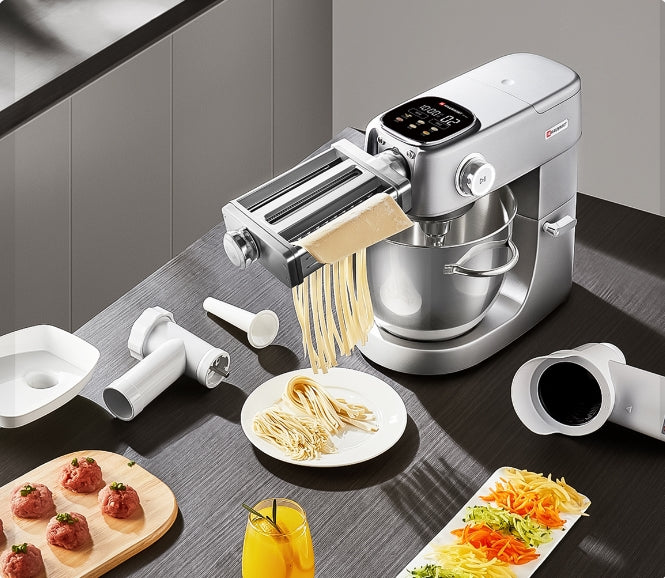
| Hauswirt M5max | 3 (noodle-making, food chopping, meat grinder) | No — Hauswirt attachments are proprietary to Hauswirt mixers | Noodle-making accessory (roller & cutter set), food chopper, meat grinder |
| Cuisinart | 5-8 | No — Cuisinart takes Cuisinart-branded attachments only | Pasta roller, meat grinder, juicer, food processor |
| Bosch Universal Plus | 15+ (largest) | No (proprietary bottom-drive) | Blender, meat grinder, citrus press, pasta set, cookie press, food processor, grater/shredder |
Bosch Has the Largest Proprietary Ecosystem
Bosch's Universal Plus wins on attachment variety by a wide margin. The four drive ports on top of the motor base allow attachments that no other brand can match — a built-in blender that mounts directly to the mixer base, for example, or a continuous-feed food processor with its own motor drive. If you want a single appliance that replaces 4-5 others, Bosch is the strongest play.
Cuisinart and Hauswirt Share Standard Front-Hub Compatibility
Both Cuisinart's Precision Master and Hauswirt's M5max put the attachment port on the front of the mixer. That is the only thing they share — each brand's hub is proprietary, so attachments come from the brand that made your mixer.
- Hauswirt's hub-mounted attachments — noodle maker, food chopper, meat grinder — work only on Hauswirt's M5, M5max, and M9. Third-party "universal-fit" attachments and KitchenAid-branded attachments do not fit.
- KitchenAid-branded attachments do not fit Cuisinart's Precision Master either; Cuisinart takes Cuisinart-branded attachments.
- Neither brand matches Bosch's blender-as-attachment option.
Practical Takeaway
If attachments are your primary decision factor, Bosch Universal Plus wins on raw variety. If you just want occasional pasta and meat grinding, Hauswirt M5max or Cuisinart SM-770 covers it with that brand's own pasta and meat-grinding attachments, sold separately.
Price and Value: What You Get for Each Dollar
Here's where the comparison gets sharp. Prices fluctuate seasonally, but typical 2026 retail looks like this:
| Model | Typical Price | What you get for that price |
|---|---|---|
| Cuisinart Precision Master SM-770 | $299-399 | 5.5-Qt, 500W AC, 12 speeds, tilt-head, 3-yr warranty |
| Hauswirt M5max | $399.99 | 6-Qt, 500W DC, 11 speeds + timer, 4.5" touchscreen, 5 presets, 2-yr warranty |
| Bosch Universal Plus | $449-499 | 6.5-Qt, 800W AC belt-drive, 4 speeds, open bowl, 1-yr base / 3-yr motor |
Value per Dollar Analysis
- Cheapest entry: Cuisinart SM-770 on sale at $299 is the lowest-cost option with a real warranty.
- Best feature-per-dollar: Hauswirt M5max at $399.99 includes the DC motor, touchscreen, timer, and presets that the others don't have at any price.
- Most powerful per dollar: Bosch Universal Plus at $449-499 delivers the highest raw wattage (800W) and largest bowl (6.5-Qt) — you're paying for capacity and durability, not features.
A useful frame: Cuisinart is the value play, Bosch is the heavy-duty play, Hauswirt is the modern-tech play. All three land within a $200 band, and the right choice depends on which dimension matters most to you.
Who Should Buy What
Concretely, here's how to choose based on what you actually bake:
Choose Cuisinart Precision Master SM-770 If:
- Your budget is $300-350 and you want a reliable tilt-head with a warranty.
- You bake occasionally — cookies, cake batter, the occasional pizza dough.
- You want a KitchenAid-like experience without the KitchenAid price.
- You don't care about touchscreens, timers, or presets.
Choose Bosch Universal Plus If:
- You bake bread weekly, especially heavy whole-grain or high-hydration doughs.
- You want to expand into a multi-function kitchen system (blender, grinder, food processor).
- You're willing to learn the open-bowl layout.
- Counter space isn't a constraint and you don't mind a 24-lb machine.
Choose Hauswirt M5max If:
- You bake bread regularly and care about low noise (kids asleep, open-concept kitchen, video calls).
- You want modern features — touchscreen, timer, presets — without paying $700+ for a smart KitchenAid.
- You want a lighter machine (16 lbs) that's easy to move and store.
- You want a 6-Qt bowl capacity that handles most household recipes without overflowing.
A reasonable summary: Cuisinart if you're optimizing for price, Bosch if you're optimizing for capacity and durability, Hauswirt if you're optimizing for modern engineering and quiet operation.
Hauswirt M5max Quick Reference
If the comparison above steered you toward Hauswirt, here's the quick spec recap:
- Price: $399.99 (Amazon retail)
- Motor: 500W DC, side-mounted
- Bowl: 6-Qt 304 stainless steel, tilt-head
- Speeds: 11 + timer
- Controls: 4.5-inch color touchscreen + dial
- Presets: 5 built-in + 2 customizable
- Attachments: 3 power hubs (front, top, bottom)
- Weight: ~16 lbs
- Noise: ~45 dB under load
- Warranty: 2 years

Hauswirt M5 Max 6QT Stand Mixer for Effortless Home Baking
500W DC Motor | 6QT Bowl | 45dB Quiet | 4.5" Touchscreen | 11 Speeds + Timer
$399.99
Frequently Asked Questions
Is Hauswirt a reliable brand?
Hauswirt has been manufacturing stand mixers for over a decade and entered the North American market with the M5/M5max lineup. The brand offers a 2-year warranty on the M5max — shorter than Cuisinart's 3-year base warranty but comparable to Bosch's 1-year base with 3-year motor coverage. Long-term (10+ year) reliability data is still accumulating because the brand is newer to the US, but the engineering choices (DC motor, stainless attachments, die-cast body) are consistent with mixers built for long service life.
How does Cuisinart compare to KitchenAid?
Cuisinart's Precision Master series uses a similar AC-motor tilt-head design to KitchenAid's Artisan, with similar 500W motor output and 5.5-Qt bowl capacity. The main differences: Cuisinart costs $100-150 less, comes with a longer base warranty (3 years vs KitchenAid's 1 year), but has fewer attachment options and doesn't have the same resale value as a KitchenAid. For buyers who don't care about the KitchenAid badge, Cuisinart is a strong value alternative.
Why is Bosch's bowl open at the top?
Bosch's Universal Plus uses a bottom-drive design where the motor sits under the bowl and turns the beater shaft from below. This allows the head to be completely empty, so you can add ingredients while the mixer runs without tilting anything out of the way. The trade-off is that the bowl has a center drive shaft that makes it harder to clean than a simple tilt-head bowl, and you need the splash ring for any flour-containing mix.
Which is quieter: Hauswirt, Cuisinart, or Bosch?
Hauswirt M5max is significantly quieter at ~45dB under load — about the level of a quiet library. Cuisinart's Precision Master runs at 75-80dB (similar to a vacuum cleaner), and Bosch's Universal Plus runs at 70-78dB (slightly quieter than Cuisinart thanks to the belt-drive). The DC motor in the Hauswirt is the fundamental reason for the noise advantage — DC motors run quieter than AC motors at equivalent torque output.
Can I use KitchenAid attachments on Cuisinart or Hauswirt?
No. Attachments are not interchangeable across these brands. Hauswirt's M5max uses its own proprietary hub, and Hauswirt attachments fit only Hauswirt mixers (M5, M5max, M9) — KitchenAid-branded and third-party universal attachments do not fit. Cuisinart's Precision Master uses its own front hub and takes Cuisinart-branded attachments. Bosch uses a proprietary bottom-drive system, so KitchenAid attachments are not compatible there either. Always buy the attachment made for your specific mixer brand and model.
What's the difference between a DC motor and an AC motor in a stand mixer?
A DC (direct current) motor delivers full torque from speed 1, runs quietly (~45dB in the Hauswirt M5max), and generates less heat. An AC (alternating current) motor needs RPMs to generate torque, runs louder (70-85dB typical), and produces more waste heat. For bread dough kneading — which happens at low speeds under heavy load — DC motors are materially better. For light tasks like whipping cream or mixing cake batter, the difference is less noticeable.
Does Bosch's belt-drive require maintenance?
Yes, eventually. The reinforced belt in Bosch's Universal Plus is designed for thousands of hours of use, but it stretches over time. Typical replacement interval is 5-10 years depending on usage. Bosch sells replacement belts for around $20-30, and the swap is a 15-minute DIY job with a screwdriver. Cuisinart and Hauswirt use gear-drive transmissions that don't have this specific wear item, though gears can wear differently under heavy load.
Which brand has the best warranty?
Cuisinart offers the longest base warranty at 3 years. Bosch offers 1 year on the overall mixer but 3 years on the motor specifically. Hauswirt offers 2 years on the complete M5max. None of these is dramatically better than the others — all three brands stand behind their products with reasonable coverage. Extended warranties are often available from retailers like Sur La Table or Williams Sonoma for any of the three.
What to Do Next
If this comparison has narrowed your choice, here's what to do:
- If you're leaning Hauswirt M5max: Read our head-to-head comparison of the Hauswirt M5max against KitchenAid — it covers the DC-motor advantage in more depth than this three-way comparison.
- If you want a step back to first principles: Our Stand Mixer Buying Guide walks through how to choose a mixer based on capacity, motor, and budget — useful if you're not yet sure what you actually need.
- If you're not sure what size you need: Our Stand Mixer Size Guide breaks down quart capacity by household size and baking style.
- If you want to see the M5max in action: Browse the full stand mixer collection on hauswirt.com or check the M5max product page for current pricing and bundle options.
- If you're weighing a stand mixer against a hand mixer: Read Hand Mixer vs Stand Mixer: Which Do You Actually Need? — sometimes the answer is "neither, you want a hand mixer."
The right mixer is the one that matches how you actually cook. Pick the engineering trade-off that fits your kitchen, and the brand name on the housing matters far less than the motor inside it.
Sources
- Hauswirt M5max official specifications, hauswirt.com/products/stand-mixer-m5max
- Cuisinart Precision Master SM-770 product literature, cuisinart.com
- Bosch Universal Plus MUM66210UC product literature, bosch-home.com
- "Stand Mixer Motor Types: AC vs DC," Prudent Reviews, 2024
- "Best Stand Mixers of 2026," Food & Wine, 2026
- r/Breadit community discussions on Bosch Universal Plus long-term use
- "Bosch Belt-Drive Maintenance Guide," Bosch Home Appliances service documentation
- Internal Hauswirt competitive analysis, 2026 (M5 Max vs Cuisinart vs Bosch comparison data)
