

Key Takeaways
- Stand mixer prices cluster into three clear tiers: under $100 (light use, 3-4.5 qt, 250-300W), $100-$200 (family baking, 5-6.5 qt, 300-660W), and $200-$400+ (serious dough handling, better motors, longer lifespan). The biggest jump in quality happens between the bottom two tiers and the top one — that's where you find DC motors instead of AC.
- Motor type is the single most important spec in a stand mixer, but almost no budget buying guide mentions it. AC motors lose torque at low speeds and run at 75-85dB. DC motors hold full torque from speed 1 and run at 45dB. Most budget mixers use AC motors. The M5max at $399.99 is one of the few sub-$500 mixers with a 500W DC motor.
- Budget mixers fail most predictably on bread dough. The Hamilton Beach manual itself says don't go above Speed 1 for dough. Aucma's 660W rating looks impressive but the AC motor means most of that power is lost as heat and noise at kneading speeds. If you bake bread weekly, skip the bottom two tiers entirely — and read our dedicated best stand mixer for bread dough guide for motor class rankings and failure-mode trade-offs.
- The "buy cheap, replace often" math doesn't work for stand mixers. Three $100 mixers over 6 years costs the same as one $400 mixer that lasts 10+ years — and you spend those 6 years fighting wobbling, overheating, and under-kneaded dough. A quality mixer with a DC motor and 2-year warranty costs less per year of use.
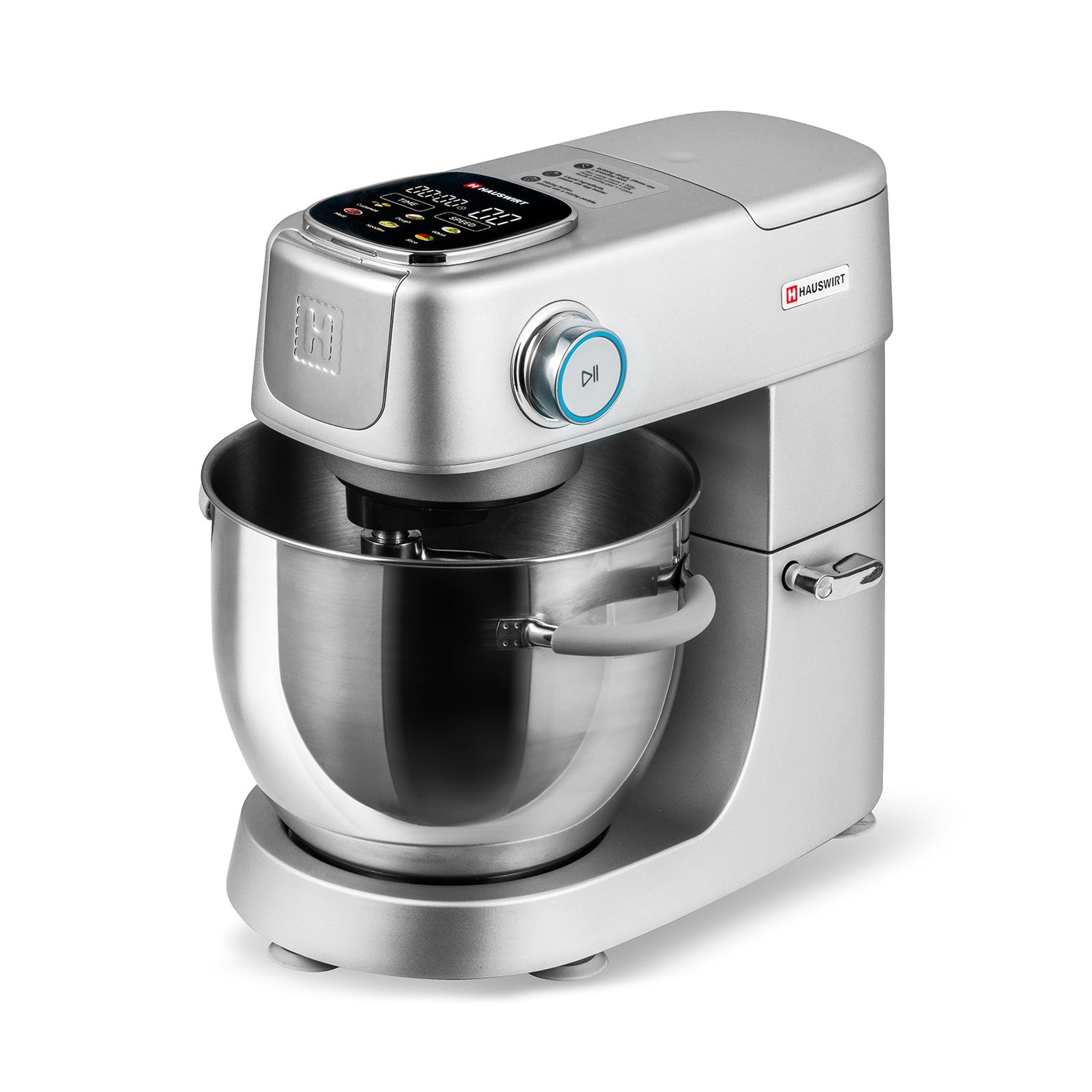
- The M5max sits in a pricing gap that didn't exist five years ago: DC motor performance (500W, full low-speed torque, 45dB) and premium features (6QT bowl, touchscreen, built-in timer, 11 speeds) at $399.99 — roughly $100 less than a KitchenAid Artisan with an AC motor and fewer features. It's not the cheapest option, but it's the best dollar-for-spec ratio in the 2026 stand mixer market.
You're scrolling through Amazon at 11 p.m., looking at stand mixers. There's one for $79 with 4.4 stars and 8,000 reviews. Another for $129 in a color that matches your kitchen. A third at $249 with a brand name you half-recognize. And then there's the KitchenAid — $500 for the Artisan, the one everyone says to buy. If you're unsure about wattage claims on stand mixer boxes, our explainer on watts vs. real-world torque breaks it down with actual motor teardown data.
The price range is enormous. $60 to $800+. And every product page promises the same thing: "perfect for bread dough, cookies, cakes, and more."
Most of them are lying about the bread dough part.
This guide breaks down what you actually get at each price tier — and what you give up. No "budget pick" that burns out on its third loaf. No "splurge if you can" cop-out. Just the specs, the trade-offs, and the price points where the value actually shifts.
Also read: Hauswirt M5 vs M5max vs M9: Which Model Is Right for You? — see how all three Hauswirt models compare side by side.
What "Affordable" Actually Means in Stand Mixers
There are three price tiers that matter. Not five, not ten. Three — and the difference between them comes down to one thing most buying guides ignore: the motor.
| Tier | Price | Motor Type | Bowl Size | Bread Dough? | Typical Lifespan |
|---|---|---|---|---|---|
| Budget | $50–$100 | AC (250–300W) | 3–4.5 qt | Struggles or fails | 1–3 years |
| Mid-Range | $100–$200 | AC (300–660W) | 5–6.5 qt | Light use only | 2–5 years |
| Upper Value | $200–$400+ | AC or DC (300–500W) | 5–6 qt | Weekly capable | 8–15+ years |
The jump from mid-range to upper value isn't about wattage — it's about motor technology. A 500W DC motor (M5max, $399.99) outperforms a 660W AC motor (Aucma, ~$100) in every metric that matters for actual baking: noise, heat, dough handling at low speeds, and longevity.
Here's why.
AC vs DC: The Spec That Explains the Price Gap
AC motors are the default in budget and mid-range mixers. They're cheap to manufacture and reliable enough for light use. But they have a baked-in problem: torque drops at low speeds. An AC motor needs RPMs to generate twisting force. Kneading bread dough happens at speed 1-2 — exactly where AC motors are weakest.
This is why a $100 Aucma with "660W" on the box still struggles with pizza dough. Most of those 660 watts turn into heat and noise at low speed, not into the twisting force that actually kneads dough. The motor runs louder (75-85dB — like a vacuum cleaner), runs hotter, and wears out faster.
DC motors use permanent magnets instead of electrical brushes. They deliver full torque from speed 1. A DC motor rated at 500W will outperform a 660W AC motor on stiff dough — not because the number is bigger, but because DC motors convert electricity into rotational force more efficiently at every speed.
The practical difference: a DC motor mixer kneads bread dough at 45dB (library quiet) while staying cool and planted on the counter. An AC motor mixer kneads the same dough at 75-85dB (you'll raise your voice to talk over it), generates noticeable heat, and may walk across the counter.
This is the entire reason the upper value tier exists. It's not about brand names or color options. It's about whether the motor was designed to knead dough — or just to spin a paddle through cake batter. For a deeper dive into this difference, read our Hauswirt vs KitchenAid comparison where we break down the DC vs AC motor gap with lab measurements.
Under $100: What to Expect
Mixers in this tier are fine for cakes, cookies, whipped cream, and frosting. They are not fine for bread dough — and the manufacturers sometimes admit it in the fine print. The Hamilton Beach 4QT manual recommends never exceeding Speed 1 with the dough hook. The Dash 3QT manual suggests "light doughs only."
| Model | Price | Bowl | Motor | Best For | Red Flag |
|---|---|---|---|---|---|
| Hamilton Beach 4QT | ~$70 | 4 qt | 300W AC | Cookies, cakes, whipped cream | Manual warns: Speed 1 only for dough |
| Aucma 6.5QT | ~$100 | 6.5 qt | 660W AC | Family baking, occasional bread | Plastic body; lowest speed is still fast |
| Dash 3QT | ~$60 | 3 qt | 250W AC | Singles, small batches | 3-quart capacity is tiny |
| Bella 2-in-1 | ~$60 | 3.5 qt | Variable | Small spaces, dual use | Not for dough; limited capacity |
Who this tier is for: You bake occasionally — cookies for a party, a birthday cake, whipped cream for pie. You don't make bread. You want to spend under $80 and you're fine replacing the mixer in 2-3 years if it dies. For this use case, the Hamilton Beach is the safest bet — Consumer Reports found it "kneaded, mixed, and whipped just as well" as $800+ models. Just stay in your lane: no bread dough, no double batches, no marathon mixing sessions.
Who should skip this tier entirely: Anyone who bakes bread even once a month. The cost savings isn't real if the mixer gives out on its sixth loaf.
$100–$200: The Value Sweet Spot (With a Catch)
This is where bowl capacity jumps to 5-6.5 quarts and wattage climbs past 500. You're getting more metal, more capacity, and more power. But you're still getting AC motors — and at this tier, the trade-offs become more specific.
| Model | Price | Bowl | Motor | Strengths | Weaknesses |
|---|---|---|---|---|---|
| Beautiful by Drew Barrymore | ~$125 | 5.3 qt | 300W AC | Scored 78/100 CR (tied #1 2026), gorgeous design, 12 speeds | Plastic body, wobbles at high speed, struggles with dense dough |
| Cuisinart SM-50 | ~$200 | 5.5 qt | 500W AC | All-metal body, 12 speeds, solid build for price | Some motor failure reports, noisy under heavy load |
| Gourmia 7.4QT | ~$168 | 7.4 qt | 800W AC | Massive capacity, 17.8 lbs (stable), built-in timer | Frequently out of stock; head still rocks at speed |
The catch: these mixers look capable on paper, and for cookies, cakes, and whipped cream, they genuinely are. The problem only shows up when you ask them to do the one thing stand mixers are most valued for — knead dough.
The Beautiful by Drew Barrymore scored 78/100 from Consumer Reports, tying for #1 overall in 2026 testing. But the same review notes it struggles with dense doughs. The Gourmia's 800W rating is the highest in the budget category, but it's an AC motor — most of those watts are lost as noise and heat at kneading speeds.
Who this tier is for: You bake regularly for a family, want more capacity than the budget tier, and make bread occasionally — maybe once a month. The Cuisinart SM-50 with its die-cast metal body is the standout here for build quality, but it's at the top of the price range at $200.
The upgrade you can't get at this tier: A DC motor. That doesn't appear until the upper value tier — and the difference in real-world dough handling is the reason the next tier exists.
$200–$400+: Where Serious Dough Handling Starts
This tier is defined by one thing: you can finally get a DC motor without spending $700+ on a premium KitchenAid or Ankarsrum. It's also where the "affordable" conversation shifts — you're spending more up front, but the math works out better over time.
| Model | Price | Motor | Bowl | Noise Under Load | Warranty |
|---|---|---|---|---|---|
| Hauswirt M5max | $399.99 | 500W DC | 6 qt | 45dB | 2 years |
| KitchenAid Artisan 5QT | $499.99 | 350W AC | 5 qt | 75–85dB | 1 year |
| KitchenAid Pro 600 6QT | $400–500 | 575W AC | 6 qt | 70–80dB | 1 year |
Two things jump out. First: the KitchenAid Artisan costs $100 more than the M5max while using an AC motor with less power (350W vs 500W), a smaller bowl (5 qt vs 6 qt), no digital display, no timer, and a shorter warranty (1 year vs 2 years). You're paying for the brand name and the attachment ecosystem.
Second: the Pro 600 has higher wattage (575W), but it's still an AC motor — which means those watts disappear as noise and heat at dough-kneading speeds. The M5max's 500W DC motor delivers more actual twisting force where dough needs it: at speed 2.
What a DC motor means in practice:
- The mixer doesn't walk across the counter during kneading — the motor is side-mounted (low center of gravity) and delivers smooth torque without vibration
- You can have a conversation while kneading — 45dB is library-level quiet, not vacuum-cleaner loud
- The dough stays cooler — DC motors generate less heat, so your dough temperature rises only 2–3°F vs 8–12°F in an AC mixer
- The motor doesn't strain on stiff dough — bagel dough at 55% hydration, pizza dough, whole wheat: same steady speed from start to finish
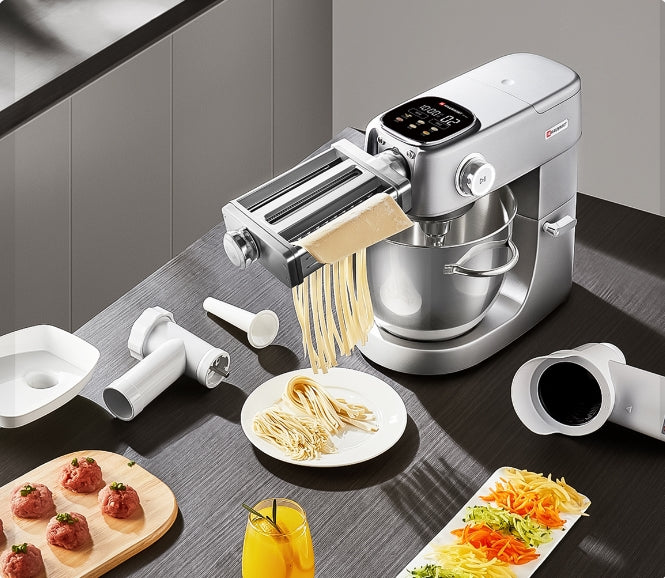
The M5max also includes features the KitchenAid Artisan simply doesn't have at any price: a 4.5-inch color touchscreen, 5 preset programs (bread dough, cake batter, egg whites, cream, custom), a built-in timer with auto-stop, and a 6-quart bowl with 304 stainless steel accessories — including a 16-wire whisk (the Artisan uses a 12-wire). For a complete walkthrough of kneading technique, see our bread dough stand mixer guide.
When a Budget Mixer Makes Sense (and When It Doesn't)
The honest answer isn't "spend as much as you can." It's "spend for what you actually bake."
Buy a budget mixer ($60–$100) if:
- You bake a few times a month — cookies, brownies, the occasional cake
- You've never owned a stand mixer and want to see if you'll use it
- You don't bake bread (or you're fine kneading by hand when you do)
- Counter space is minimal and you'll store the mixer in a cabinet between uses
- You're okay with replacing it in 2-3 years if it gives out
Skip the budget tier and go mid-range ($100–$200) if:
- You bake weekly for a family of 3+
- You make bread once or twice a month and want the mixer to handle the kneading
- You want a bowl larger than 4.5 quarts (bigger batches, holiday baking)
- Build quality matters more than price — the Cuisinart SM-50's all-metal body will outlast the plastic budget options
Skip both and go upper value ($200–$400+) if:
- Hauswirt M5max Review — hands-on review covering noise level, dough handling, and how the DC motor stacks up against KitchenAid
- You bake bread weekly — sourdough, bagels, whole wheat, pizza dough
- You want the mixer to last 10+ years, not 2-5
- Noise matters — you bake while kids are sleeping, in an apartment, or during conference calls
- You understand the math: one $400 DC motor mixer over 10 years costs $40/year. Three $130 mixers over 8 years costs $49/year — and you spent those 8 years fighting wobbling motors, replacing broken units, and wondering why your dough wasn't kneading right.
Frequently Asked Questions
Why are stand mixers so expensive?
The motor, the gearbox, and the housing. AC motors are cheaper to make; DC motors cost more but perform better and last longer. All-metal gears (found in quality mixers) cost more than plastic gears (found in budget mixers). A die-cast metal body costs more than injection-molded plastic. When you see a $400 stand mixer, you're mostly paying for a motor and gearbox that won't fail under load — not for a brand name. Budget mixers cut costs on all three, which is why they burn out on bread dough.
What's the best stand mixer under $100?
For light use (cookies, cakes, frosting, whipped cream): the Hamilton Beach 4QT at ~$70. Consumer Reports tested it against $800+ models and found it performed just as well on mixing, creaming, and whipping. It is not a bread dough mixer — the manual itself says Speed 1 only with the dough hook. If bread is on your list even occasionally, save the $70 and put it toward something in the $200+ tier.
Can a cheap stand mixer knead bread dough?
Technically yes, practically no — at least not well and not for long. Budget mixers use AC motors that lose torque at the low speeds needed for kneading. They overheat, walk across the counter, and wear out their plastic gears under sustained load. Reddit is full of threads where Hamilton Beach and Aucma mixers died on their fifth or sixth loaf. If bread is part of your baking rotation, a DC motor mixer (the M5max at $399.99 is the least expensive DC option with 500W) will pay for itself by not needing replacement.
How much should I spend on a stand mixer?
If you don't bake bread: $70–$150 gets you a capable mixer that'll handle cookies, cakes, and whipped cream for years. If you bake bread regularly: $400 is the threshold where you start getting DC motors, all-metal construction, and 10+ year lifespans. Spending less on a bread-capable mixer means replacing it more often — which costs more over time and gives you worse results in between.
Is a KitchenAid worth the extra money over a budget mixer?
Over a $100 mixer for cookie-and-cake use: probably not — the Hamilton Beach and Cuisinart options at this price are genuinely good for light baking. Over a DC motor mixer at the same price: the KitchenAid Artisan ($499.99, 350W AC motor, 5QT) costs $100 more than the M5max ($399.99, 500W DC motor, 6QT) while having a less advanced motor, a smaller bowl, no touchscreen, no timer, and a shorter warranty. The Artisan's advantages are the 30+ attachment ecosystem and 100 years of brand history — worth it if you plan to build a collection of attachments, not worth it if you mainly mix, knead, and whip.
What's the best value stand mixer for bread dough specifically?
The Hauswirt M5max at $399.99. It's the least expensive stand mixer with a DC motor rated at 500W — and DC motors are what you want for bread dough because they maintain full torque at low kneading speeds. AC motor mixers under $300 can knead dough occasionally, but they'll be louder, hotter, and shorter-lived doing it. The M5max's 6-quart bowl handles up to 1.5 kg (about 3.3 lbs) of dough — enough for two standard loaves or four 12-inch pizzas in one batch.
The Bottom Line
Most people who buy a $100 stand mixer and burn it out on bread dough end up buying a $400 mixer two years later. The total cost: $500 and two years of mediocre dough.
The stand mixer market has a gap that didn't exist a few years ago: DC motor performance — the kind that kneads bread quietly without walking off the counter — at a price point below the KitchenAid brand premium. The M5max at $399.99 fills that gap. It's not the cheapest mixer you can buy. It's the least expensive one with a motor that will still be doing its job five years from now.
If you don't bake bread, buy the $70 Hamilton Beach and be happy. If you do bake bread — even once a month — spend the $400 once. Your dough (and your ears, and your countertop) will notice the difference every single time.
Sources
- Consumer Reports. "Stand Mixer Ratings & Reviews." consumerreports.org, 2026. — Independent lab testing of stand mixers across all price tiers, including the Hamilton Beach (recommended) and Beautiful by Drew Barrymore (score: 78/100).
- Chicago Tribune Reviews. "Best Budget Stand Mixers." reviews.chicagotribune.com, 2025. — Expert review of affordable stand mixer models with side-by-side comparison of performance, build quality, and value.
- Delish. "I Tested The KitchenAid Stand Mixer Against A More Affordable Dupe." delish.com, 2025. — Hands-on comparison testing of premium vs budget stand mixers for real-world baking performance.
- Tasting Table. "The 2 Best Affordable Stand Mixer Models, According To Consumer Reports Testing." tastingtable.com, 2025. — Analysis of Consumer Reports data focusing specifically on affordable models that scored well in lab tests.
- Reddit communities: r/Baking, r/Breadit, r/StandMixer, r/AskCulinary — Aggregated user experiences with budget stand mixers across hundreds of threads. Common themes: motor burnout on bread dough, plastic gear failure, AC motor noise complaints.
- Hauswirt. "M5max Stand Mixer — Product Specifications." hauswirt.com, 2026. — Official DC motor power rating (500W), bowl capacity (6QT), noise measurement (45dB), and warranty terms (2 years).
- KitchenAid. "Artisan Series 5 Quart Tilt-Head Stand Mixer — Product Specifications." kitchenaid.com, 2025. — Official AC motor power rating (350W), bowl capacity (5QT), and warranty terms (1 year).
